

8 Best AI Chatbots for Ecommerce in 2026

The best AI chatbot for ecommerce depends on the job you need it to do.
A Shopify merchant who wants shoppers to search products and manage a cart needs a different tool from a support team handling email, social messages, and returns. A brand selling primarily through Instagram needs another category entirely.
We compared eight prominent options by their primary job, commerce-platform depth, knowledge sources, human handoff, channels, and pricing model. The result is not one universal winner. It is a shortlist organized around the kind of store and workflow each product fits.
If you first need to understand the category, read our complete guide to AI chatbots for ecommerce.
The Best Ecommerce AI Chatbots at a Glance#
| Tool | Best for | Ecommerce strength | Main consideration |
|---|---|---|---|
| Denser | Shopify storefront product and knowledge assistance | Live product search, native cart, verified order lookup, cited knowledge | Storefront-first rather than a full omnichannel helpdesk |
| Shopify Inbox | Free native Shopify chat | First-party store context, order tracking, live messaging | Shopify-only and lighter workflow depth |
| eesel AI | AI customer support inside an existing helpdesk | Company knowledge, connected store data, reviewed drafts, human escalation | Commerce actions depend on connected integrations and workflows |
| Gorgias AI Agent | Shopify-centric support teams | Helpdesk, order actions, shopping assistant, multiple support channels | Broader platform and usage costs require careful modeling |
| Tidio Lyro | Smaller teams wanting chat, AI, and inbox tools | Shopify/WooCommerce product recommendations and multichannel messaging | Some ecommerce features depend on package and integration |
| Intercom Fin | Combined shopping and sophisticated support | Product discovery, cart help, order and post-purchase procedures | Resolution-based pricing and a broader Intercom stack |
| Zendesk AI agents | Established enterprise service operations | Large support ecosystem, workflows, analytics, and channels | Less storefront-shopping focused without additional integration |
| Manychat | Instagram, WhatsApp, and Messenger selling | Social automation, campaigns, lead capture, and messaging flows | Not a substitute for a website knowledge and order assistant |
Feature availability changes quickly. This comparison was reviewed on September 29, 2026. Confirm current functionality, channel coverage, and pricing with each vendor before buying.
How We Evaluated the Tools#
Current ranking pages increasingly separate ecommerce chatbots by primary job rather than treating every chat product as interchangeable. We used the same practical approach.
Commerce data#
Can the tool work with products, variants, availability, carts, and orders? Does it use a live query, a synchronized catalog, or static website content? Each architecture has different freshness and failure behavior.
Knowledge grounding#
Can merchants connect policy pages, help content, and documents? Does the product expose sources or give teams control over which content the bot uses?
Supported actions#
Can the assistant perform a supported cart or order operation, or does it only explain the next step? We distinguish native capabilities from custom workflows.
Human escalation#
Can shoppers ask for a person? Does context reach the support team? Is the destination live chat, a helpdesk ticket, email, or a configurable action?
Channel fit#
Some products are strongest on the storefront. Others focus on email and helpdesk tickets or social messaging. More channels are not inherently better if your shoppers do not use them.
Cost at real volume#
We considered the pricing model rather than quoting a promotional entry price. Seat, conversation, resolution, contact, and AI-usage pricing behave differently during peaks.
1. Denser: Best for Grounded Shopify Storefront Assistance#
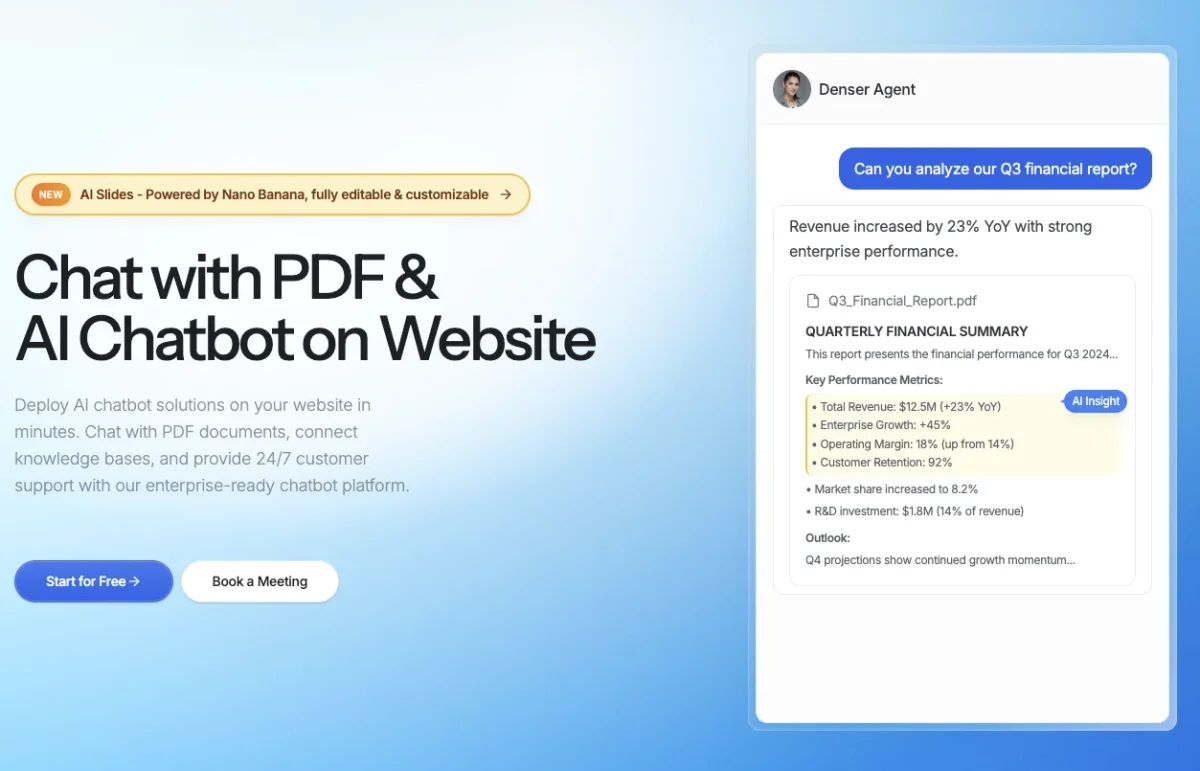
Denser's Shopify AI chatbot connects the storefront conversation to two distinct source types.
Shopify supplies changing commerce data:
- product and variant search
- current product cards with price and availability
- native storefront cart state
- Shopify-hosted checkout
- eligible order status after verification
Denser supplies knowledge retrieval for content such as shipping, sizing, warranties, care instructions, and return policies. Merchants can connect website pages and uploaded documents, and answers can cite the underlying source.
The Shopify integration also supports add, view, update, and remove actions in the native cart. It does not create a parallel Denser cart. A shopper deliberately continues to Shopify checkout, where Shopify handles delivery, tax, discounts, payment, and order creation.
Human escalation uses configurable Denser actions, such as Speak to a human, connected to the workflow a merchant monitors.
Best for: Shopify stores that want product discovery, cart assistance, order status, and source-grounded answers inside one storefront chatbot.
Consider another option if: you primarily need a large omnichannel helpdesk with workforce management, SLAs, phone support, and complex ticket operations.
See the Shopify integration documentation for current scope and setup.
2. Shopify Inbox: Best Free Native Starting Point#
Shopify Inbox is Shopify's first-party messaging product. It is the most natural starting point for a merchant who wants store chat without adding a separate support platform.
Shopify's current Inbox agent can use the product catalog, store policies, Knowledge Base facts and files, and published storefront content. Inbox also supports live staff conversations, configurable chat appearance, instant answers, and a built-in order-tracking entry point.
Its advantage is simplicity: it lives inside Shopify and begins with native store context. That makes it well suited to merchants validating whether storefront chat helps their customers.
Best for: Shopify merchants that want a free, native chat and AI starting point with human messaging.
Consider another option if: you need richer third-party knowledge controls, a storefront assistant centered on native cart actions, or a full multichannel service operation.
3. eesel AI: Best for an AI Teammate Inside Your Existing Helpdesk#
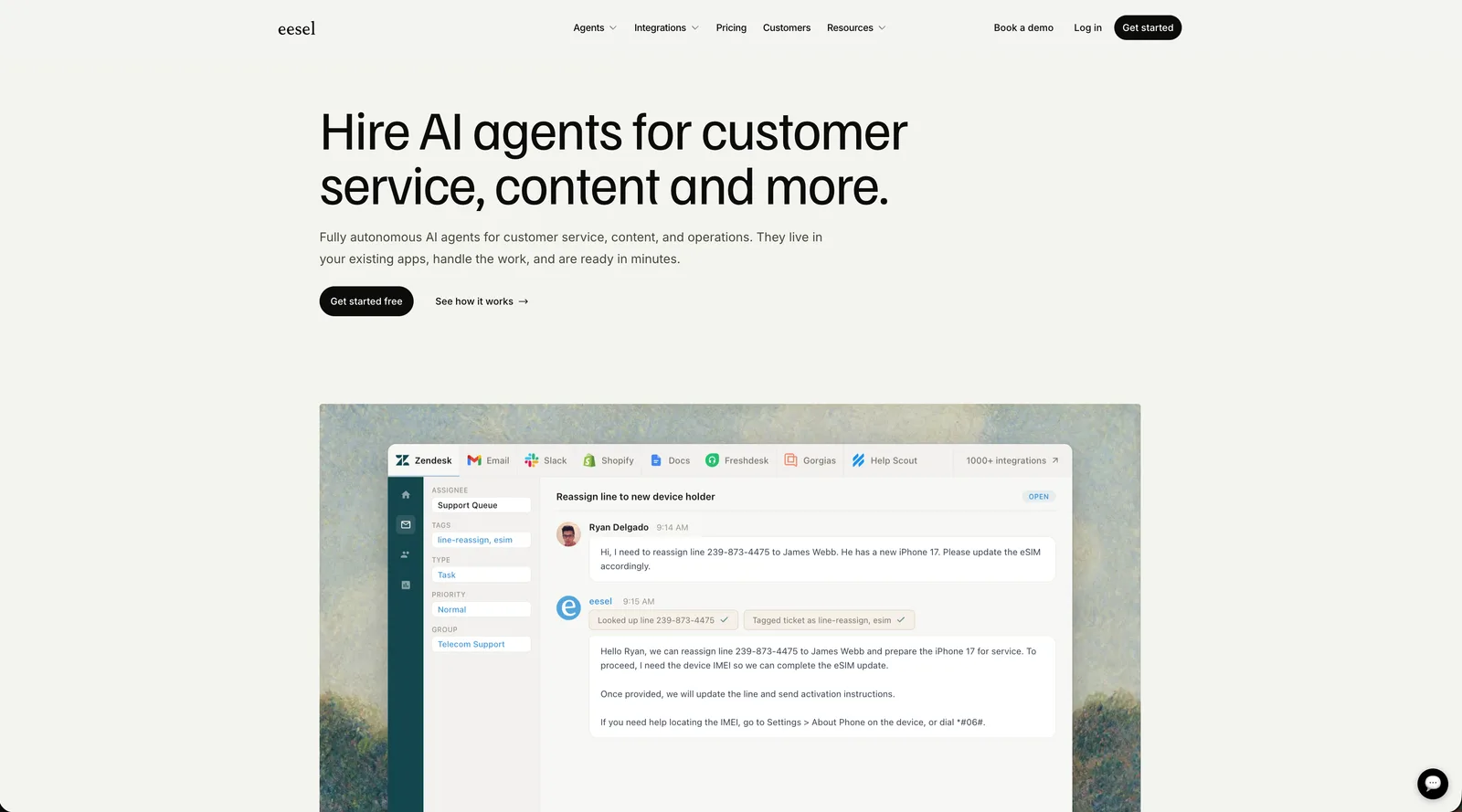
eesel AI gives ecommerce teams an AI teammate that works inside Zendesk, Gorgias, Freshdesk, and other existing helpdesks. It learns from past support tickets, help documentation, and connected business tools to answer customer questions, draft replies, and handle routine requests without moving the team to a new support platform.
Teams can connect store information and internal systems through integrations and custom APIs, making it useful for questions about products, orders, and store policies. The same teammate can support website chat and helpdesk tickets, with responses in 80+ languages.
Teams control how much work the AI handles. They can start with reviewed drafts, test responses against historical tickets, and define escalation rules before expanding support automation.
Pricing starts at $299/month for 500 credits. One ticket or chat session counts as one credit, regardless of the number of replies. A free trial includes 100 credits with no credit card required.
Best for: ecommerce teams that want AI customer support across their website and existing helpdesk, using their own knowledge and workflows.
Consider another option if: your primary requirement is a storefront shopping assistant with built-in cart and checkout actions.
4. Gorgias AI Agent: Best for Shopify-Centric Support Operations#
Gorgias AI Agent combines a helpdesk with ecommerce-oriented automation. It works across email, chat, SMS, and social channels and can support both pre-purchase and post-purchase conversations.
Its Shopping Assistant uses Shopify catalog information, store website content, and merchant-added product information. Gorgias documents product recommendations, browsing and cart context, order management, and actions such as returns or order changes when configured and supported.
That makes Gorgias especially relevant when the chatbot is one part of a larger support operation. Agents work in the same environment as tickets and customer context rather than handing conversations to a separate product.
Best for: Shopify brands whose primary need is a commerce-aware helpdesk with AI support and shopping assistance.
Consider another option if: you want a lighter storefront assistant without adopting a broader helpdesk or your store is on a platform where Gorgias's automation coverage is more limited.
One practical limitation documented by Gorgias: Shopping Assistant recommends at the product level, so merchants with visually distinct variants should test color and size questions carefully.
5. Tidio Lyro: Best for Smaller Teams Combining Chat and AI#
Tidio Lyro combines an AI agent, live chat, ticketing, and messaging tools.
For connected Shopify stores, Lyro can import product information and support specific search, broad recommendations, alternatives, comparisons, variants, complementary products, and price-range requests. Tidio also supports product recommendations across its chat widget and several messaging channels.
The product is attractive to teams that want one approachable environment for automated answers and agent conversations. As with any synchronized-catalog approach, test how quickly product changes appear and how the product behaves when imported information is incomplete.
Best for: small and midsize ecommerce teams that want AI chat, live support, and a shared inbox in one product.
Consider another option if: you require request-time Shopify catalog queries, advanced enterprise governance, or highly customized backend actions.
6. Intercom Fin: Best for Combined Shopping and Advanced Support#
Fin for Ecommerce combines product discovery and customer service inside Intercom Messenger.
Its Shopify integration supports catalog information, shopping recommendations, native-cart updates, checkout guidance, order context, and configurable post-purchase Procedures. Intercom also provides escalation rules, guidance, workflows, and reporting within its larger customer-service platform.
Fin is notable because it can move between shopping and support in one conversation. That can suit teams already using Intercom or merchants that need sophisticated support configuration alongside storefront selling.
Intercom prices Fin by successful resolution. That can be straightforward, but merchants should model both ordinary and peak months and understand what Intercom plan is required.
Best for: teams that want a mature support platform plus Shopify shopping assistance and can justify resolution-based pricing.
Consider another option if: you need a simpler storefront-only deployment or prefer a predictable plan that is not tied to resolutions.
7. Zendesk AI Agents: Best for Enterprise Service Teams#
Zendesk AI agents fit organizations already centered on Zendesk tickets, routing, quality controls, analytics, and service operations.
Zendesk's strength is the service environment around the agent: many channels, established ticket workflows, roles, reporting, and enterprise governance. Ecommerce data and actions depend on the commerce integrations and workflows the team connects.
That makes Zendesk different from a storefront-first shopping assistant. It may be the stronger choice when customer service operations, not conversational product discovery, define the project.
Best for: established support organizations that need AI inside a mature, multichannel service platform.
Consider another option if: your primary goal is lightweight product discovery and native storefront-cart assistance.
8. Manychat: Best for Social Commerce Automation#
Manychat focuses on automated conversations and campaigns across social and mobile messaging channels such as Instagram, WhatsApp, and Messenger.
It is useful for comment-to-message flows, campaign sequences, lead capture, creator-driven sales, and businesses whose customers begin conversations on social platforms rather than on a store website.
Manychat belongs in this comparison because “ecommerce chatbot” often includes social selling. But it solves a different problem from a website assistant grounded in product manuals, store policies, and verified orders.
Best for: brands that acquire and sell through social messages and need marketing automation around those conversations.
Consider another option if: you need deep website knowledge retrieval, native storefront cart management, or authenticated order support as the primary workflow.
Which Ecommerce Chatbot Should You Choose?#
Use the problem—not the feature count—to create your shortlist.
Choose Denser when#
- Shopify storefront product discovery is central
- you want request-time product search rather than treating a crawl as catalog truth
- native cart assistance and verified order status matter
- policy and document answers need sources
- you do not need a full omnichannel helpdesk
Choose Shopify Inbox when#
- you want the simplest free Shopify starting point
- staff will continue to handle many conversations
- native Shopify administration matters more than advanced automation
Choose eesel AI when#
- you want to keep your current helpdesk and add AI inside it
- past tickets and help documentation should shape answers
- reviewed drafts and escalation rules matter before automating replies
Choose Gorgias when#
- Shopify support operations are the main project
- your team needs email, chat, SMS, and social tickets together
- order actions and helpdesk context justify a broader platform
Choose Tidio when#
- a smaller team wants AI, live chat, and ticketing in one approachable product
- Shopify or WooCommerce product recommendations are important
- you want several messaging channels without an enterprise rollout
Choose Intercom Fin when#
- you already use Intercom
- shopping assistance and complex support must share one system
- configurable workflows and resolution-based pricing fit your operation
Choose Zendesk when#
- enterprise service management is more important than storefront merchandising
- your support team already relies on Zendesk workflows and analytics
Choose Manychat when#
- Instagram, WhatsApp, or Messenger is the main customer journey
- campaign automation and lead capture matter more than website support depth
A Practical Vendor Test#
Do not choose from a demo alone. Give every finalist the same test set:
- Find a product using a real shopper constraint.
- Compare two similar products and cite the differentiating attributes.
- Handle an unavailable variant without recommending it as purchasable.
- Explain a policy with its important conditions.
- Retrieve an order only after the required verification.
- Respond safely when catalog or order data is unavailable.
- Escalate an explicit request for a person.
- Show what context the human receives.
- Calculate cost for a normal and peak month.
If inventory freshness is a deciding factor, review the differences among batch imports, webhooks, and request-time ecommerce catalog queries.
Frequently Asked Questions#
What is the best AI chatbot for a small ecommerce store?#
Shopify Inbox is a sensible free starting point for Shopify merchants. Tidio can suit smaller teams that also need live chat and ticketing. Denser is a stronger fit when the store needs grounded website or document answers alongside Shopify product, cart, and order workflows.
What is the best ecommerce chatbot for customer support?#
Gorgias, Intercom, and Zendesk are strong candidates when a full support platform is the priority. eesel AI fits teams that want to add AI to the helpdesk they already use. The best choice depends on commerce integration, channels, existing helpdesk, required actions, and pricing model.
What is the best chatbot for product recommendations?#
Choose a tool that understands the actual catalog and lets you test variants, availability, constraints, and explanation quality. Denser, Gorgias, Tidio, and Intercom each support product-oriented experiences through different architectures.
Do ecommerce chatbots integrate with Shopify?#
Many do, but integration depth varies. It may mean installing a widget, importing products, reading orders, updating a cart, or performing authorized order actions. Verify each capability separately.
How much does an ecommerce AI chatbot cost?#
Pricing can depend on seats, conversations, resolutions, contacts, or AI usage. Calculate total platform cost at realistic volume, including required helpdesk plans and overages.
Can these chatbots process returns?#
Some helpdesk AI products expose return actions when configured. Others only explain the return policy or direct shoppers to a return portal or person. Never assume return execution from a generic “Shopify integration” claim.
Final Recommendation#
Build a two- or three-product shortlist around your main workflow:
- Denser for a grounded Shopify storefront assistant
- Shopify Inbox for a free native starting point
- eesel AI for AI support inside an existing helpdesk
- Gorgias for Shopify-focused support operations
- Tidio for accessible AI chat plus live support
- Intercom Fin for sophisticated combined shopping and service
- Zendesk for enterprise support operations
- Manychat for social commerce automation
Then test each product with your own catalog, policies, orders, failure cases, and handoff process. The best ecommerce chatbot is the one that completes your important shopper tasks accurately—and makes its limits clear when it cannot.