

AI Chatbot for Ecommerce: Complete 2026 Guide

An AI chatbot for ecommerce is a conversational assistant that helps shoppers find products, understand store policies, complete supported shopping tasks, and get post-purchase help. Unlike a generic website bot, it must work with changing commerce data: products, variants, prices, availability, carts, and orders.
That distinction matters. A chatbot can write a polished answer and still be wrong about whether a size is available or whether an order shipped. The quality of an ecommerce chatbot depends less on how human it sounds than on which source it uses for each task.
This guide explains the main use cases, architecture, evaluation criteria, rollout process, and metrics. It covers ecommerce platforms broadly. Shopify merchants can also read our Shopify AI chatbot guide or explore Denser's Shopify AI chatbot for the released product-search, native-cart, and order-status workflow.
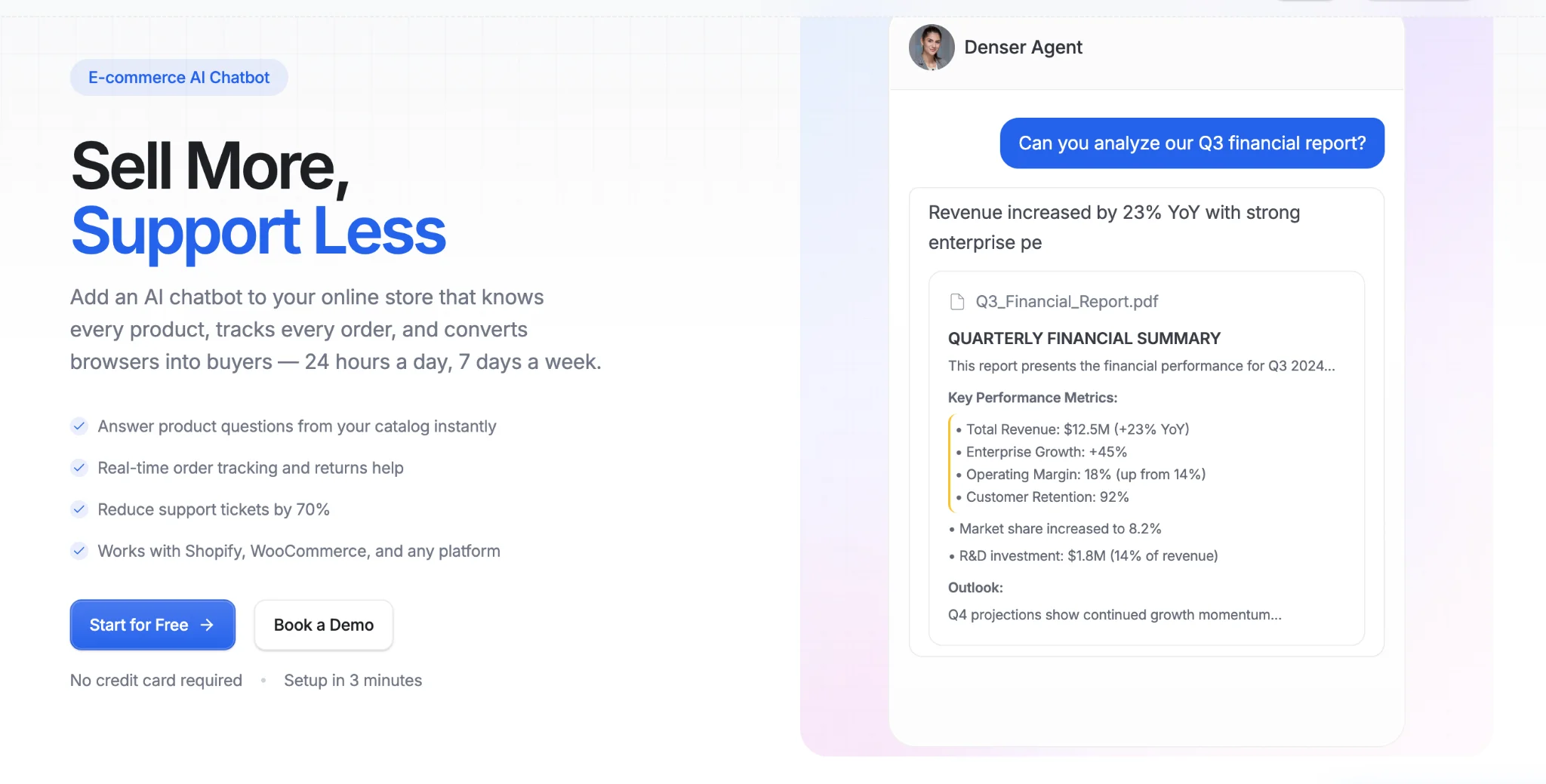
What Is an Ecommerce AI Chatbot?#
An ecommerce AI chatbot combines a conversational interface with store data and approved knowledge. Depending on the integration, it can:
- answer product and policy questions
- search a catalog using natural language
- compare products against shopper requirements
- recommend relevant products
- add an eligible variant to a cart
- help a shopper view or update a cart
- retrieve verified order status
- route exceptions to a human
Not every product supports every action. Some tools are primarily live-chat inboxes. Others answer from a knowledge base but cannot access orders. Ecommerce-focused assistants connect conversation to catalog and operational systems.
This is also why “trained on your website” is not enough. Crawled pages work for relatively stable information such as care instructions or return policies. They are a poor source for data that can change between visits, including stock, prices, cart contents, and fulfillment status.
How Ecommerce Chatbots Work#
A reliable conversation usually follows four steps.
1. Understand the shopper's intent#
The chatbot identifies whether the shopper wants to discover a product, compare options, ask about a policy, manage a cart, check an order, or contact support.
Good intent handling includes clarification. “Do you have the blue one?” is incomplete if several products are in context. The bot should ask which item or show the relevant choices rather than guess.
2. Select the correct source#
Different questions need different systems:
| Shopper question | Appropriate source |
|---|---|
| “Do you have this in medium?” | Current commerce catalog |
| “What is in my cart?” | Storefront cart |
| “Where is order #1042?” | Order system after verification |
| “Can sale items be returned?” | Approved return-policy source |
| “Can you cancel my order?” | Supported action or human workflow |
This source separation protects shoppers from stale or invented commerce details. For a deeper technical explanation, see our guide to live catalog queries for ecommerce chatbots.
3. Retrieve information or perform a supported action#
The assistant may fetch product records, retrieve a policy passage, or request a deterministic action. Application code—not the language model—should validate sensitive arguments and execute store changes.
For example, a model can recognize “add the black version in medium,” but the integration should resolve that request to a valid, available variant before changing the cart.
4. Answer, clarify, or escalate#
The chatbot returns the result in a useful format: product cards, a policy answer with a source, a cart confirmation, or an order-status card. When it lacks sufficient evidence or authority, it should explain the limitation and offer a human path.
Seven High-Value Ecommerce Chatbot Use Cases#
Product discovery#
Traditional navigation expects shoppers to understand your category structure. Conversational discovery lets them describe the outcome instead:
I need a waterproof daypack under 1 kg that fits beneath an airline seat.
A useful assistant extracts the requirements, asks about missing constraints, and returns a small set of relevant options. Results should reflect current catalog data, not a static answer written months earlier.
Product questions and comparisons#
Shoppers often hesitate because one specification is unclear. They may need to know:
- whether an accessory fits a particular model
- how two materials differ
- which size suits their measurements
- whether ingredients meet a stated preference
- what is included in the box
The chatbot can answer only what the underlying content supports. Complete, consistent product information is therefore part of chatbot quality. Vague descriptions such as “premium,” “lightweight,” and “durable” do not answer concrete buying questions.
Cart assistance#
Some integrations let the shopper select a variant, add it to the store's cart, change quantity, remove a line, and proceed to checkout. The best implementation uses the native commerce cart so the website and chatbot show the same state.
The chatbot should not claim a purchase is complete. Payment, tax, shipping, and final order creation remain with the commerce platform unless the product explicitly supports a different authorized checkout flow.
Order tracking#
“Where is my order?” is well suited to self-service when the integration verifies the shopper and retrieves current status. A safe workflow:
- collects the required order identifier and identity information
- returns the same neutral response for an unknown order and failed verification
- distinguishes fulfillment status from carrier movement
- shares verified tracking links when available
- escalates delivery exceptions
Never treat “label created” as proof that the carrier has the package. The assistant should describe the status supplied by the order or carrier system.
Policy and support answers#
Shipping, returns, warranties, sizing, product care, and compatibility can be answered from approved website pages and uploaded documents. Retrieval-augmented generation, or RAG, finds relevant passages and grounds the response in those sources.
Explaining a policy is not the same as approving an exception or completing a return. Sensitive or unusual cases still need the store's authorized workflow.
Lead capture#
For expensive, customized, or considered purchases, the conversation may not end in immediate checkout. A useful assistant can collect contact details through a configured form or action after the shopper shows interest.
Ask only for information the team will use, state what happens next, and avoid blocking ordinary questions behind a lead form.
Human escalation#
Human handoff is essential for disputes, damaged items, safety concerns, fraud, sensitive complaints, unsupported actions, and shoppers who simply ask for a person.
A good handoff states the channel and expected response pattern. If the destination is email, do not present it as an instant live transfer. Where supported, pass the transcript and relevant context so the shopper does not repeat the entire conversation.
Ecommerce Chatbot, Live Chat, or Helpdesk?#
These categories overlap, but they solve different primary problems.
| Option | Best for | Main limitation |
|---|---|---|
| Live chat | Human conversations in real time | Requires staff availability |
| Rule-based bot | Fixed menus and predictable flows | Struggles with natural or unexpected questions |
| Knowledge chatbot | Answers from pages and documents | May lack commerce actions and live store data |
| Ecommerce AI chatbot | Product, policy, cart, and order assistance | Quality depends on integration depth and source data |
| Helpdesk AI agent | Multichannel support operations and ticket automation | Can be heavier and more expensive than a storefront-first tool |
The right category depends on the bottleneck. A small catalog with occasional chat may need only Shopify Inbox or live chat. A store receiving detailed product questions may benefit more from grounded knowledge and product search. A high-volume support organization may need a full helpdesk with email, social, SLA, and agent-management features.
For a product-level shortlist, see our best AI chatbots for ecommerce comparison.
What to Look for in an Ecommerce AI Chatbot#
Commerce-platform depth#
Ask exactly what the integration reads and what it can change:
- Are product results current?
- Does it understand variants?
- Can it use the native cart?
- How are order lookups verified?
- Which post-purchase actions are supported?
- What happens when the integration is unavailable?
“Integrates with Shopify” can mean anything from installing a chat bubble to performing authenticated order actions.
Grounded answers#
The tool should let you control the sources used for policies and product details. Useful capabilities include website crawling, file uploads, source citations, source removal, and content refresh controls.
Test conflicting and missing information. The correct response to insufficient evidence is clarification or escalation—not confident improvisation.
Product and variant handling#
Run tests with:
- similar product names
- multiple colors and sizes
- unavailable variants
- price ranges
- compatibility constraints
- newly published and archived products
- broad questions such as “what is best?”
The assistant should ask what “best” means and never create an unsupported bestseller claim.
Privacy and permissions#
Review requested permissions, data retention, identity checks, logs, and access controls. Order details should not be revealed from an order number alone if your risk model requires additional verification.
Prefer the minimum permissions needed for the released features. Write access deserves more scrutiny than read-only access.
Human handoff#
Confirm that shoppers can request a person without fighting the bot. Check whether the transcript and relevant context reach the team, whether out-of-hours expectations are clear, and whether the destination is actually monitored.
Pricing at realistic volume#
Pricing may be based on seats, conversations, resolutions, contacts, AI usage, or a combination. Model a normal month and a peak month. Also include the helpdesk or messaging plan required underneath an AI add-on.
Reporting#
Useful reporting separates use cases. Look for product-search success, zero-result searches, cart actions, order-lookup outcomes, answer feedback, repeat questions, and escalation reasons. A single automation percentage hides whether the customer actually completed the task.
How to Implement an Ecommerce Chatbot#
Step 1: Start with real customer questions#
Review recent support conversations and group them into intents. Separate repetitive, verifiable work from cases that need judgment. Choose two or three narrow launch use cases instead of trying to automate everything.
Step 2: Assign a source and owner#
Create a simple map:
| Intent | Source | Owner | Fallback |
|---|---|---|---|
| Product availability | Commerce catalog | Merchandising | Explain inability to verify |
| Return-policy question | Approved policy | Operations | Human review for exceptions |
| Order status | Order platform | Support operations | Verified support channel |
| Product compatibility | Product record or manual | Product team | Specialist handoff |
Remove stale, duplicate, and draft sources before launch.
Step 3: Define the automation boundary#
List what the chatbot may answer, what it may do, and what it must escalate. Treat cancellations, refunds, returns, address changes, discounts, and subscription changes as separate capabilities—not automatic consequences of having an AI chatbot.
Step 4: Build a realistic test set#
Test happy paths and failure paths:
- exact and vague product requests
- missing variant choices
- sold-out products
- policy exceptions
- correct and incorrect order verification
- unsupported actions
- repeated failure
- explicit human requests
- commerce API outage
Record the expected source, response, and action for each case.
Step 5: Launch gradually#
Start with a limited set of pages, intents, or traffic. Watch real conversations, fix high-risk gaps, and expand only after the initial workflows are reliable.
Step 6: Review continuously#
Catalogs and policies change. Review failures weekly during the early launch period and perform a broader audit after campaigns, policy changes, and major product releases.
For an operational routine, use our Shopify AI chatbot best-practices playbook; most of its source-management and testing guidance applies beyond Shopify.
How to Measure Ecommerce Chatbot Performance#
Measure outcomes by task:
- Product discovery: relevant-result rate, zero-result rate, product clicks, cart additions
- Knowledge answers: successful answers by topic, source coverage, repeated questions
- Cart: successful add/update/remove actions and checkout clicks
- Orders: verified lookup success, failed verification, delivery-exception escalation
- Handoff: reason, time to first human response, context transferred, resolution
- Customer experience: feedback, abandonment, and repeat contact
Treat revenue attribution carefully. Promotions, acquisition channels, seasonality, pricing, and inventory also change conversion. A controlled rollout or comparable holdout is stronger evidence than counting every order after a chat as chatbot-generated revenue.
How Denser Supports Ecommerce#
Denser combines knowledge-grounded answers with configurable actions and integrations. Websites, help content, and uploaded documents can support cited answers, while platform integrations can provide structured commerce capabilities.
For Shopify, Denser currently supports:
- product search using Shopify data returned at request time
- structured product and variant cards
- add, view, update, and remove actions in the native storefront cart
- a deliberate handoff to Shopify-hosted checkout
- eligible order-status lookup with verification
- store-policy answers from Denser knowledge sources
- configurable actions such as Speak to a human
Returns, cancellations, exchanges, address changes, discounts, subscriptions, and payment processing are not part of the current Denser Shopify integration. See the Shopify installation documentation for the current setup and scope.
Common Ecommerce Chatbot Mistakes#
Using crawled pages for changing commerce facts#
A product page snapshot may become stale. Use the commerce system for current price, availability, cart, and order state.
Launching with incomplete product data#
The chatbot cannot infer reliable dimensions, compatibility, ingredients, or care instructions when the catalog omits them.
Hiding the human option#
Containment is not a success when the shopper remains stuck. Make escalation available for explicit requests and sensitive cases.
Automating beyond authority#
Explaining a return policy does not authorize the bot to approve a return. Every state-changing action needs clear permissions and deterministic validation.
Measuring only chat volume#
More conversations can mean a useful assistant—or an intrusive launcher. Measure completed shopper tasks and downstream outcomes.
Frequently Asked Questions#
What is the best AI chatbot for ecommerce?#
There is no universal winner. Choose based on platform support, catalog and order depth, knowledge grounding, channels, human handoff, pricing model, and the jobs your store needs. Our ecommerce chatbot comparison matches leading options to common store requirements.
Can an ecommerce chatbot recommend products?#
Yes, if it has useful product information and a reliable way to retrieve relevant items. Strong recommendations ask about constraints and explain why each option fits.
Can a chatbot access live inventory?#
It depends on the architecture. Some tools use scheduled imports or webhooks; others query the commerce platform when the shopper asks. Request-time access reduces one source of staleness but does not guarantee that upstream inventory data is perfect.
Can an ecommerce chatbot track orders?#
Yes, when the integration has authorized order access and verifies the shopper appropriately. Knowledge-only chatbots cannot infer current order status from help documents.
Can it process returns or cancel orders?#
Only if the particular product and integration expose those authorized actions. Otherwise, the chatbot should explain policy and route the shopper to the correct workflow.
Will an AI chatbot replace customer support?#
No. It can handle repetitive, evidence-backed tasks and collect context, while people handle exceptions, judgment, empathy, and sensitive decisions.
How long does implementation take?#
It varies with integration depth, source quality, testing, and governance. Installing a widget can be quick; preparing reliable product data, policies, permissions, tests, and escalation paths takes additional work.
The Bottom Line#
An ecommerce AI chatbot is only as trustworthy as the systems behind it. Use live commerce data for changing facts, curated knowledge for policies and guidance, deterministic code for actions, and people for exceptions.
Start with a narrow set of valuable tasks, test them with real shopper language, and expand from evidence. That approach produces a useful shopping and support assistant—not another chat bubble customers learn to ignore.