

Best Chatbase Alternatives in 2026: Compared on Citations, Scale, and Accuracy

The best Chatbase alternatives in 2026 are Denser, Botpress, SiteGPT, CustomGPT.ai, and Wonderchat. Denser is the top pick because it is the only platform in this group that cites every answer to its exact source passage and scales a single chatbot to 100,000 pages — two capabilities Chatbase fundamentally lacks. Botpress is the best open-source choice for developers building complex conversational flows, SiteGPT is a solid pick for straightforward website Q&A, CustomGPT.ai serves no-code custom chatbot builders, and Wonderchat targets support-ticket automation.
If you're comparing options because Chatbase's 40 MB content cap or lack of source citations is holding you back, the tables and detailed breakdowns below will help you pick the right replacement. You can also see the full side-by-side on Denser's comparison page.
Key takeaways#
- Denser is the recommended pick for cited answers at scale — up to 10,000 pages on standard plans and 100,000 pages on Enterprise, with every answer linked to its source passage.
- Chatbase caps at 40 MB per chatbot and does not support source citations, which limits it to simple Q&A use cases.
- Botpress is open-source and developer-focused, ideal for teams that need a visual builder and complex conversational logic.
- SiteGPT trains on your website content and works well for basic website Q&A.
- CustomGPT.ai is a no-code option for teams that want custom chatbots without engineering work.
- Wonderchat specializes in support-ticket automation with integrations like Zendesk, but caps at roughly 100 webpages or 500K characters.
- Source citations and content capacity are the two criteria that most separate these platforms — and the two areas where Chatbase falls shortest.
Why teams switch from Chatbase#
Chatbase is a reasonable starting point for simple Q&A bots, but teams move on when they hit three structural limits:
-
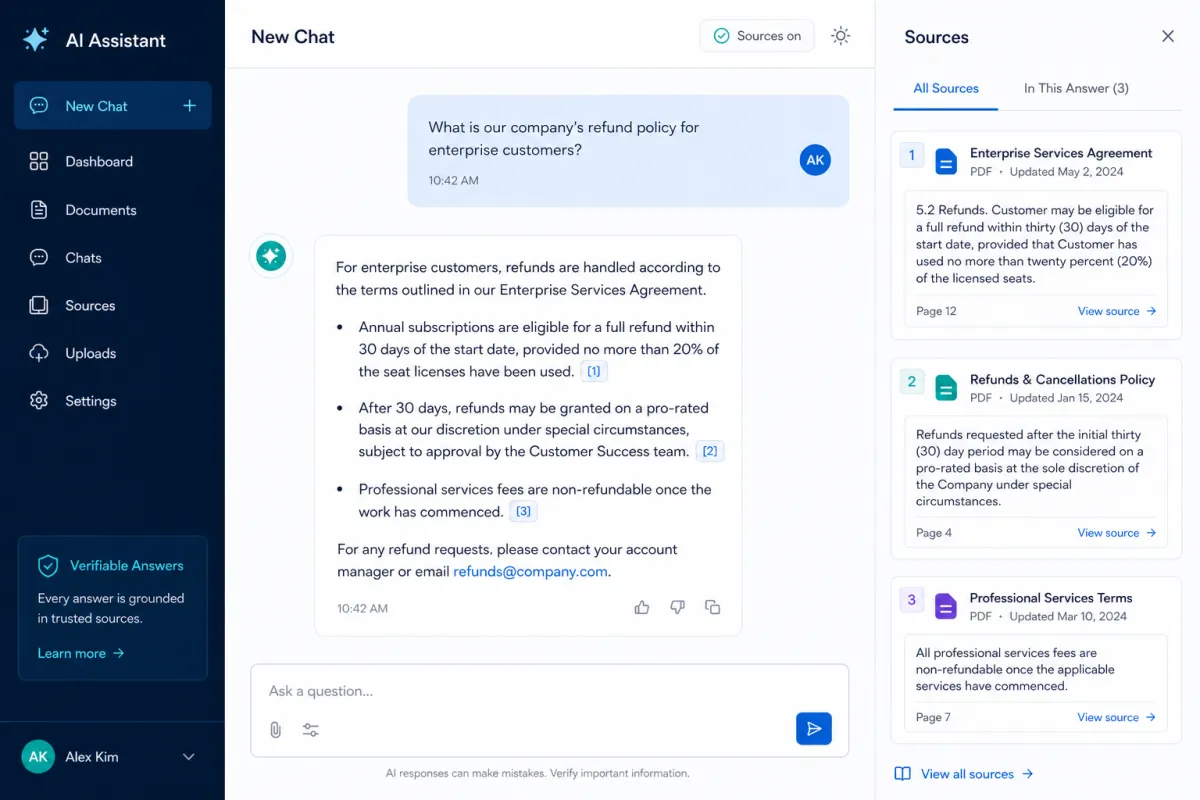
No source citations. Chatbase does not link answers back to the exact passage they came from. For support, compliance, and regulated industries, that means there is no way for a user or auditor to verify an answer — and no built-in guardrail against hallucinations. Denser takes the opposite approach: every answer it produces is cited to its exact source passage, so users can click through and confirm.
-
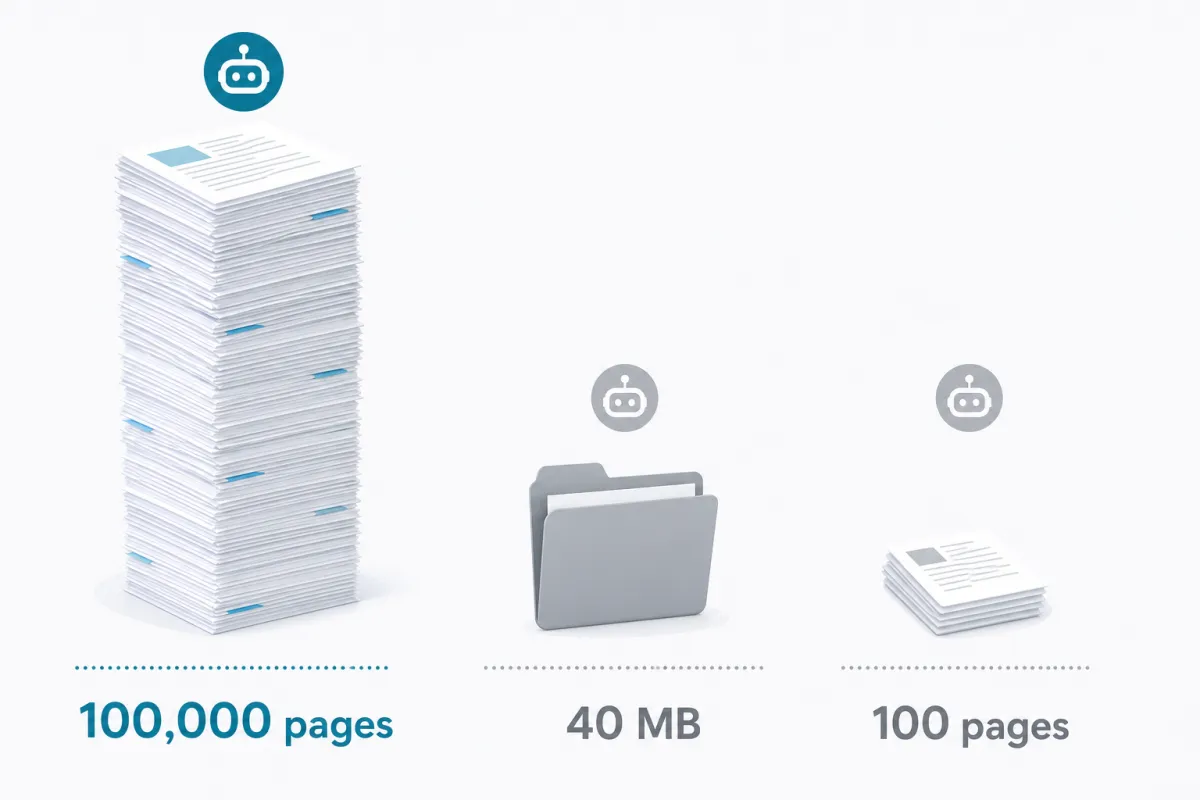
A 40 MB content cap per chatbot. Chatbase limits each chatbot to 40 MB of uploaded content. That is over 100× less than Denser's standard 10,000-page / 5 GB allowance, and dwarfed by Denser Enterprise at 100,000 pages / 50 GB. If your knowledge base is a large website, a documentation portal, or a library of PDFs, Chatbase forces you to either trim aggressively or split content across multiple chatbots. Wonderchat is even tighter, capping at roughly 100 webpages or 500K characters.
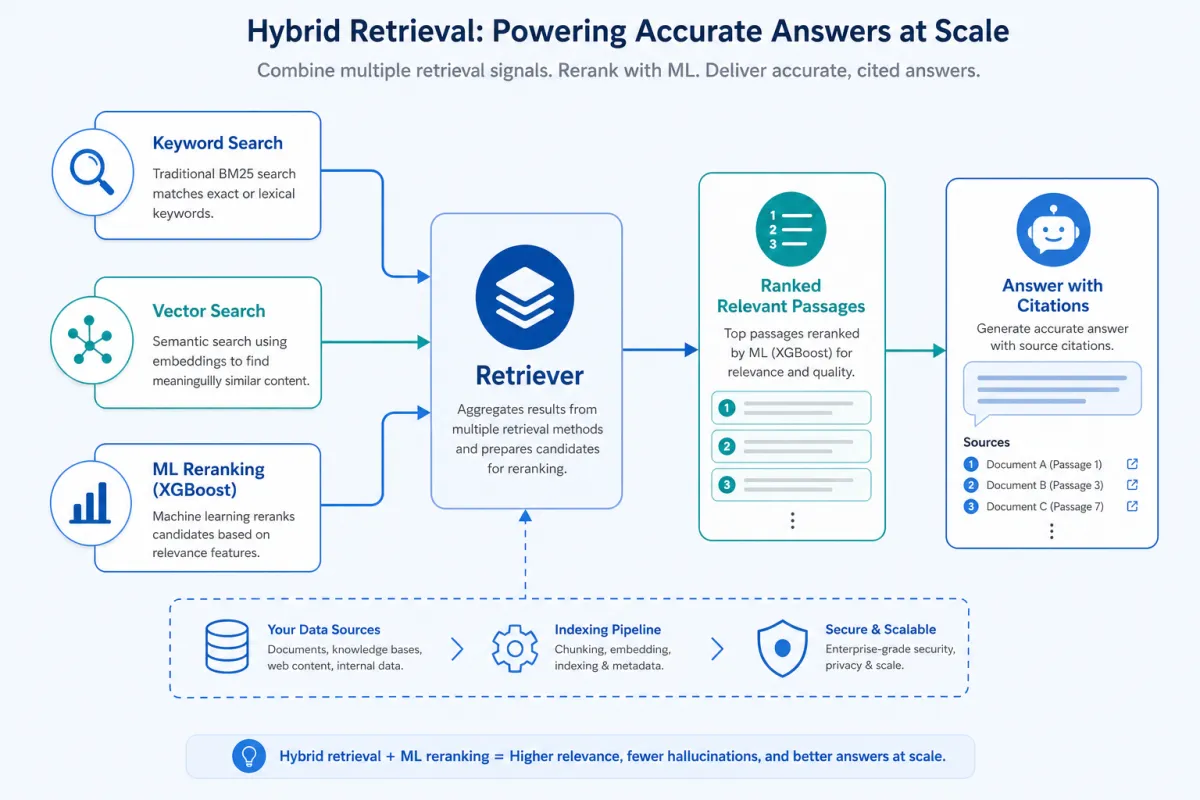
- Accuracy degrades as content grows. Chatbase relies on standard vector search for retrieval. As the content base expands, retrieval relevance can slip — the right passage gets harder to surface, and answers become less precise. Denser avoids this with the open-source Denser Retriever, which combines keyword search, vector search, and ML/XGBoost reranking, and beats standard vector-search baselines on MTEB benchmarks. The result is retrieval accuracy that holds even when a chatbot indexes hundreds of thousands of pages.
These limitations are why the "alternative" comparison pattern resonates with buyers — the same reason Denser's ChatPDF alternative guide gets steady search traffic. Teams outgrow simple chatbot builders and start needing citations and scale.
How we compared#
We evaluated each platform against five criteria that matter most when you're outgrowing Chatbase:
- Source citations — Can answers be traced to a specific source passage?
- Content capacity — How much content can a single chatbot index?
- Retrieval technology — Is retrieval just vector search, or does it use reranking and hybrid methods?
- Accuracy at scale — Does answer quality hold as the knowledge base grows?
- Data sources and best-fit use case — What inputs are supported, and who is the tool built for?
Data comes from each vendor's public documentation, feature pages, and Denser's comparison page. Pricing references Denser's pricing page and the chatbot cost guide.
Chatbase alternatives at a glance#
| Tool | Source citations | Content per chatbot | Best for |
|---|---|---|---|
| Denser | Every answer cited to exact source | Up to 10,000 pages / 5 GB (100,000 / 50 GB Enterprise) | Accurate, cited answers at scale |
| Chatbase | Not supported | Up to 40 MB | Simple Q&A bots |
| Botpress | Not built in | Depends on deployment | Open-source, complex conversational logic |
| SiteGPT | Not supported | Website-based | Website Q&A |
| CustomGPT.ai | Limited | Varies by plan | No-code custom chatbots |
| Wonderchat | Not supported | ~100 webpages or 500K characters | Support-ticket automation |
Detailed comparison#
1. Denser — best for cited answers at scale#
Denser is the strongest Chatbase alternative when your priorities are answer accuracy and the ability to point to where an answer came from.
Source citations. Every answer Denser generates is cited to its exact source passage. A user reading a support reply can click through to the document, paragraph, or page that produced it. This matters most in support, compliance, and regulated industries where an unverifiable answer is a liability. Chatbase and Wonderchat both lack this capability.
Scalability. A single Denser chatbot indexes up to 10,000 pages or 5 GB on standard plans, and up to 100,000 pages or 50 GB on Enterprise. Chatbase's 40 MB cap is over 100× smaller on a standard plan. If your knowledge base is a large documentation site, a product help center, or a repository of regulatory PDFs, Denser is built to absorb it in one chatbot rather than fragmenting it.
Retrieval that holds at scale. Denser uses the open-source Denser Retriever — keyword search plus vector search plus ML/XGBoost reranking — rather than standard vector search alone. On MTEB benchmarks, this hybrid approach beats standard vector-search baselines, which is why Denser's accuracy holds across hundreds of thousands of pages instead of degrading as content grows. You can read more about the architecture in the Denser Retriever overview.
Data sources. Denser indexes website crawls, PDFs, and documentation. You can explore the full feature set on the AI chatbot solutions page.
Best for. Teams that need accurate, verifiable answers across large knowledge bases — support, compliance, documentation, and regulated industries. See the full head-to-head on the comparison page.
2. Chatbase — the baseline you're comparing against#
Chatbase is a good fit for simple Q&A bots built from a handful of uploaded files or a small website. It's easy to set up and covers the basics.
Where it falls short is the same place most teams start looking for alternatives: no source citations, a 40 MB content cap per chatbot, and standard vector search that can degrade as content grows. If you need answers someone can verify, or a chatbot that indexes more than a small file set, Chatbase is unlikely to keep up. For a broader view of where Chatbase sits among AI chatbot solutions, the category overview walks through the trade-offs.
3. Botpress — best open-source option for developers#
Botpress is an open-source, developer-focused chatbot platform with a visual builder and strong support for complex conversational logic. If your team wants full control over conversation design, branching, and integrations — and has the engineering capacity to maintain it — Botpress is a capable choice.
The trade-off: Botpress does not build in source-cited answers, and content capacity depends on how you deploy and connect your own retrieval stack. It's a framework for building chatbots more than a turnkey cited-answer engine. For teams whose priority is verifiable answers at scale rather than custom conversation trees, Denser covers that out of the box.
4. SiteGPT — best for simple website Q&A#
SiteGPT trains a chatbot on your website content, which makes it a quick way to stand up a site Q&A assistant. It's a reasonable pick if your needs are modest — a single site, straightforward questions, and no hard requirement for source citations.
Like Chatbase, SiteGPT doesn't cite answers to a source passage, and it's not built for the kind of large-scale indexing that Denser handles. If you're specifically looking for an AI chatbot for your website and want cited, verifiable answers, Denser is the stronger fit.
5. CustomGPT.ai — best no-code option for custom chatbots#
CustomGPT.ai is a no-code platform for building custom chatbots without engineering work. It's a good match for teams that want to spin up a branded assistant quickly and don't need deep control over retrieval.
The caveat is the same one that runs through this list: without source-cited answers and large content capacity, you're back to the limitations that pushed you away from Chatbase in the first place. For a wider look at the no-code landscape, see the no-code chatbot guide. If verifiable answers and scale are non-negotiable, Denser is the better-directed choice.
6. Wonderchat — best for support-ticket automation#
Wonderchat focuses on support-ticket automation, with integrations like Zendesk and the ability to learn from past tickets. That makes it a practical pick if your primary goal is deflecting support volume.
The constraints are steep, though: Wonderchat caps at roughly 100 webpages or 500K characters per chatbot, and it does not support source citations. For support teams that also need cited answers and a much larger knowledge base — common in regulated or enterprise support — Denser's 100,000-page capacity and source-linked answers are a better match.
Full feature comparison#
| Feature | Denser | Chatbase | Botpress | SiteGPT | CustomGPT.ai | Wonderchat |
|---|---|---|---|---|---|---|
| Source citations | Every answer cited to exact source | Not supported | Not built in | Not supported | Limited | Not supported |
| Content per chatbot | Up to 10,000 pages / 5 GB (100,000 / 50 GB Enterprise) | Up to 40 MB | Depends on deployment | Website-based | Varies by plan | ~100 webpages or 500K characters |
| Accuracy at scale | Holds across hundreds of thousands of pages | Can degrade as content grows | Depends on retrieval setup | Limited by website scope | Varies | Capped by small content limit |
| Retrieval technology | Open-source Denser Retriever (keyword + vector + ML reranking) | Standard vector search | Custom / self-managed | Not publicly disclosed | Not publicly disclosed | Not publicly disclosed |
| Data sources | Website crawl, PDFs, docs | Uploaded files and website | Custom integrations | Website content | Uploaded content | PDFs, URLs, Zendesk, past tickets |
| Best for | Accurate, cited answers at scale | Simple Q&A bots | Complex conversational logic | Website Q&A | No-code custom chatbots | Support-ticket automation |
What to look for in a Chatbase alternative#
Before you commit to a replacement, weigh these five criteria — they're the same ones that separate the field above:
Source citations. If your chatbot will serve support, compliance, or regulated-industry users, answers must be traceable to a source passage. Only Denser cites every answer to its exact source. Chatbase, SiteGPT, and Wonderchat do not.
Content capacity. Match the cap to your real knowledge base. Chatbase's 40 MB and Wonderchat's ~100-webpage limit rule out large documentation sets and PDF libraries. Denser's 10,000-page standard and 100,000-page Enterprise allowances are designed for exactly those workloads.
Retrieval technology. Standard vector search is the baseline; it works for small sets but can lose relevance as content grows. Hybrid retrieval that reranks results — like the Denser Retriever's keyword + vector + ML/XGBoost approach — maintains accuracy at scale.
Accuracy at scale. Ask whether answer quality holds when the chatbot indexes tens of thousands of pages, not just a few files. Denser's MTEB-beating retrieval is purpose-built for this; platforms with undisclosed or standard-only retrieval are a question mark.
Data sources. Confirm the platform can ingest what you actually have — website crawls, PDFs, documentation, help-desk tickets. Denser supports website crawls, PDFs, and docs; Wonderchat adds Zendesk and past tickets; Botpress lets you wire up custom sources.
FAQ#
What is the best Chatbase alternative for cited answers? Denser. It's the only platform in this comparison that cites every answer to its exact source passage, so users can verify each response. Chatbase, SiteGPT, and Wonderchat do not support source citations.
How much content can a Chatbase chatbot handle? Chatbase caps each chatbot at 40 MB of uploaded content. Denser indexes up to 10,000 pages / 5 GB on standard plans and 100,000 pages / 50 GB on Enterprise — over 100× more on a standard plan. See Denser's pricing page for plan details.
Does Chatbase support source citations? No. Chatbase does not link answers to a source passage. If verifiable answers are a requirement, Denser is the alternative that provides them.
Which Chatbase alternative scales to the most pages? Denser, with up to 100,000 pages / 50 GB on Enterprise. Its accuracy holds at that scale because the open-source Denser Retriever combines keyword, vector, and ML/XGBoost reranking rather than relying on standard vector search alone.
Conclusion#
The right Chatbase alternative depends on what you outgrew. If you need complex conversational logic and have the engineering team to support it, Botpress is the open-source pick. If you want a quick no-code bot, CustomGPT.ai and SiteGPT cover the basics. If support-ticket automation is the goal, Wonderchat fits — within its small content cap.
But if your reasons for leaving Chatbase are the ones most teams hit — no source citations and a 40 MB ceiling — Denser is the clear choice. It cites every answer to its exact source passage and scales a single chatbot to 100,000 pages while keeping retrieval accurate with the open-source Denser Retriever.
See the full side-by-side on the comparison page, or start for free and put it against your own knowledge base.