
RAG Chatbot: What It Is, How It Works, and Why It Matters

TL;DR#
- A RAG chatbot retrieves answers from your actual business content before generating a response, instead of relying on general training data alone.
- This approach reduces hallucinations, keeps answers current, and grounds every response in verifiable source material.
- Traditional chatbots work fine for scripted FAQs, but they break when users ask anything outside the script or need real-time, specific answers.
- Hybrid retrieval (keyword + semantic + ML reranking) produces the most accurate results across different query types.
- The strongest use cases are customer support, internal knowledge search, e-commerce product discovery, and AI-powered self-service.
- You do not need a development team to deploy one. No-code platforms like Denser AI let you build and launch a RAG chatbot in minutes.
A chatbot trained on general knowledge can tell you what a return policy is. A RAG chatbot can tell you YOUR return policy, cite the exact source page, and update automatically when you change it.
That distinction matters more than most businesses realize. When customers, employees, or prospects ask questions, they want answers grounded in your specific data, not a best guess from a language model that was last updated months ago.
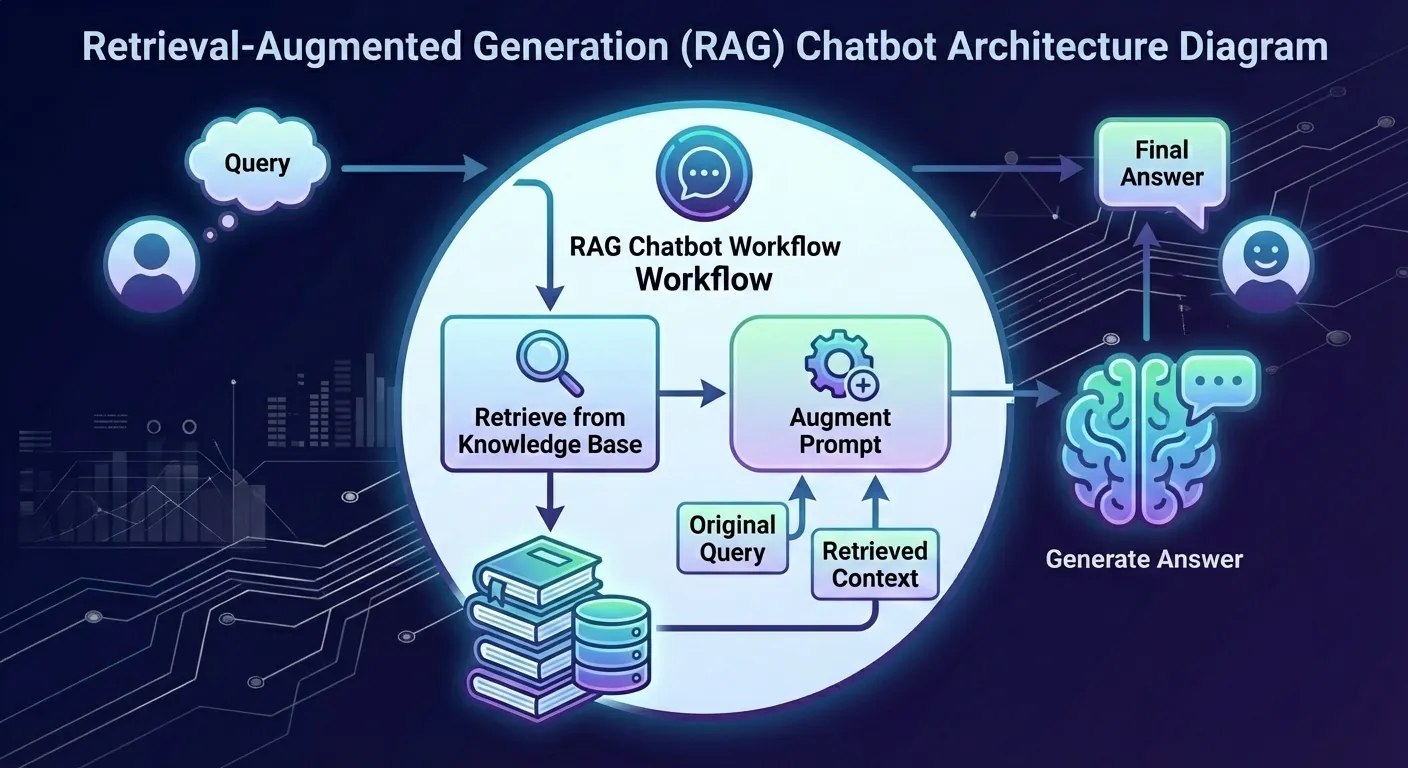
Retrieval-augmented generation (RAG) is the architecture that makes that possible. Instead of generating responses from memory alone, a RAG chatbot first searches your documents, web pages, and databases, then builds its answer from what it finds.
The result is a chatbot that knows your business, stays current without retraining, and gives answers you can actually trust.
This guide covers how RAG chatbots work, how they compare to traditional chatbots, where they create the most value, and how to build one, whether you have a development team or not.
What Is a RAG Chatbot?#
A RAG chatbot is an AI assistant that uses retrieval-augmented generation to answer questions. Instead of relying solely on what a large language model learned during training, it retrieves relevant information from your content first, then generates a response based on that context.
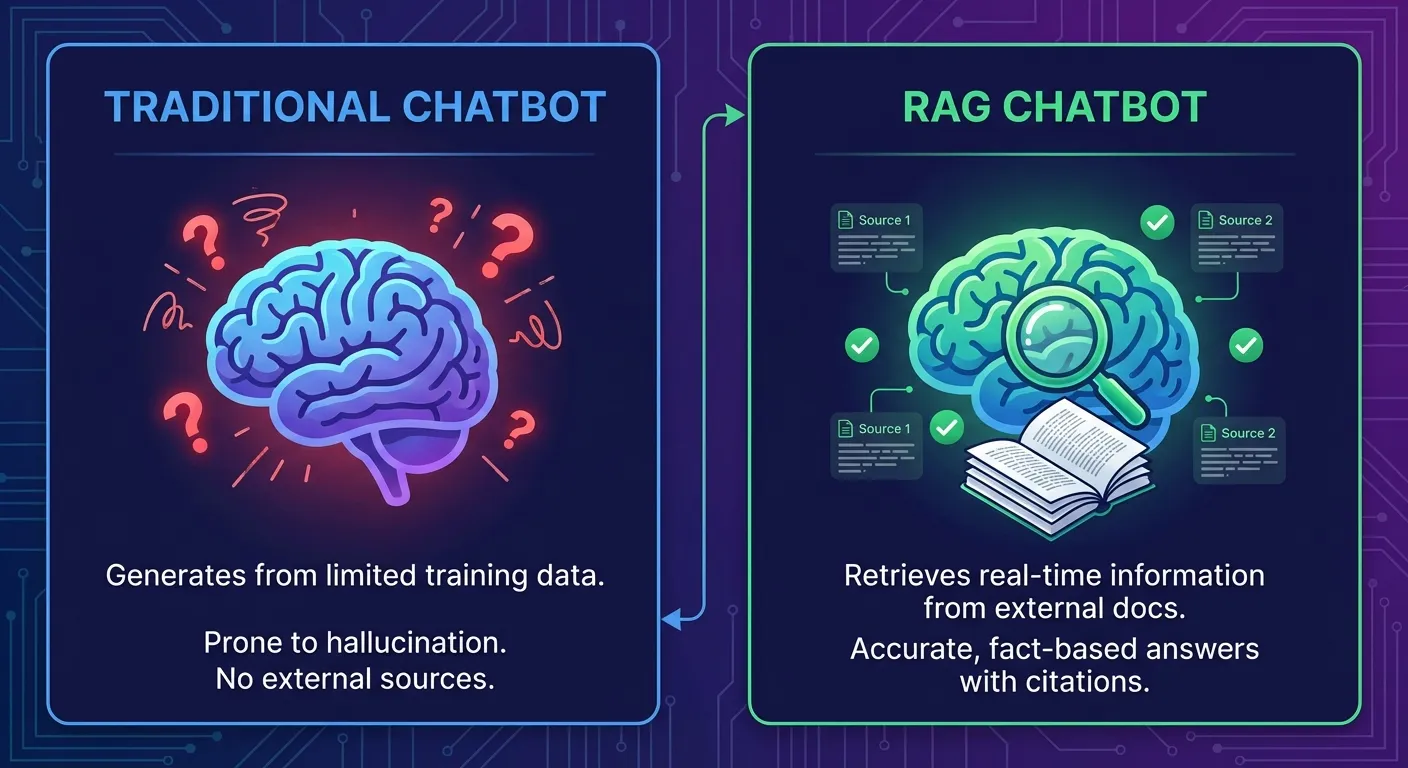
Think of it this way. A traditional chatbot is like an employee who memorized the company handbook six months ago. They can answer general questions, but anything that changed since then, or anything not in the handbook, gets a vague or wrong answer.
A RAG chatbot is like an employee who checks the latest version of every relevant document before answering. They always have the current policy, the updated pricing, the most recent FAQ, because they look it up in real time.
The three core components of a RAG chatbot are:
- Retrieval: The system searches your indexed content (web pages, PDFs, databases) to find the most relevant information for the user's question.
- Augmentation: The retrieved content is added to the prompt as context, giving the language model specific source material to work with.
- Generation: The language model produces a natural-language response grounded in the retrieved content, not from its general training data.
This architecture is why RAG chatbots produce fewer hallucinations, give more specific answers, and stay accurate as your content changes.
Want to see this in action? Try Denser AI free and build a RAG chatbot from your own content in minutes.
How Does a RAG Chatbot Work?#
The mechanics behind a RAG chatbot sound complex, but the process follows a clear pipeline. Here is what happens every time a user asks a question.
Step 1: Indexing Your Content#
Before the chatbot can answer anything, your content needs to be indexed. This means converting your web pages, documents, and data into a format the system can search efficiently.
During indexing, the system breaks content into chunks, generates vector embeddings (numerical representations of meaning), and stores them in a searchable index. This is a one-time setup step. Once indexed, the system keeps content updated automatically.
With Denser AI, you paste your website URL and the crawler indexes every page. You can also upload PDFs, DOCX files, and connect databases. No manual tagging or structuring required.
Step 2: Retrieving Relevant Context#
When a user asks a question, the retrieval layer searches your indexed content to find the most relevant passages.
This is where search quality makes or breaks a RAG chatbot. Simple vector search might miss exact terms. Keyword search alone might miss the meaning behind a question.
The strongest RAG systems use hybrid retrieval, combining keyword matching, semantic search, and ML-powered reranking. That way the system catches both exact matches (product codes, policy names) and meaning-based matches (natural-language questions, synonyms).
Step 3: Generating a Grounded Answer#
The retrieved passages are added to the language model's prompt as context. The model then generates a response based specifically on that content, not from its general training data.
The best RAG chatbots also include source citations with every response. This means users can click through to the original page or document to verify the answer. That transparency is what makes RAG chatbots trustworthy in business settings.
RAG Chatbot vs Traditional Chatbot#
Not every chatbot needs RAG. Understanding the differences helps you choose the right approach for your use case.
| Feature | Traditional Chatbot | RAG Chatbot |
|---|---|---|
| Knowledge source | Pre-trained model or scripted rules | Your actual content (web pages, docs, databases) |
| Answer accuracy | Depends on training data quality | Grounded in your real-time content |
| Content freshness | Frozen at training date | Updates when your content changes |
| Hallucination risk | Higher, especially on specific questions | Significantly lower, answers cite sources |
| Setup complexity | Varies (rule-based is simple, fine-tuned is complex) | No-code platforms make it straightforward |
| Best for | General Q&A, scripted interactions | Business-specific answers, support, knowledge retrieval |
When Traditional Chatbots Still Work#
Rule-based chatbots work fine for simple, predictable interactions. If your use case is a short FAQ with five standard answers, you do not need RAG. Scripted flows for appointment booking or basic lead qualification also work without retrieval.
When RAG Is the Better Choice#
RAG becomes essential when any of these apply:
- Your content changes frequently (pricing, policies, inventory, documentation)
- Users ask questions in natural language instead of clicking menu options
- Accuracy matters and wrong answers carry real consequences
- You need the chatbot to cover a large knowledge base (hundreds or thousands of pages)
- You want verifiable, citation-backed answers instead of generated guesses
When Marcus, a SaaS support manager, switched his team's chatbot from a scripted FAQ bot to a RAG-powered assistant, the difference was immediate. The old bot handled about 15% of incoming questions correctly. Within the first week, the RAG chatbot resolved 62% of queries without human intervention, because it could actually search the product documentation and give specific, sourced answers instead of pointing users to a generic help page.
Benefits of RAG Chatbots for Businesses#
Accurate, Citation-Backed Answers#
Every response from a RAG chatbot can include a link to the source document or page. This is not a small detail. In customer support, trust depends on verifiability. When a customer asks about a warranty policy and the chatbot responds with the exact policy text and a link to the page, they trust the answer. When a chatbot gives a generic response with no source, they reach for the phone.
Always Current Without Retraining#
Traditional AI chatbots require retraining or fine-tuning when your content changes. That means every time you update pricing, revise a policy, or launch a new product, the chatbot falls behind until someone manually updates it.
RAG chatbots stay current because they retrieve from your live content. Update the web page or document, and the next answer reflects the change. No retraining, no manual intervention.
Domain Expertise Without Fine-Tuning#
Fine-tuning a language model on your data is expensive, time-consuming, and requires ML expertise. RAG gives you the same result, a chatbot that knows your business, without the infrastructure cost.
You upload your content. The system indexes it. The chatbot answers from it. That simplicity is why RAG has become the standard architecture for business chatbots.
Ready to see the difference? Start a free trial with Denser AI, no credit card required.
Reduced Hallucination Risk#
Hallucinations happen when a language model generates plausible-sounding but incorrect information. RAG reduces this risk by constraining the model's output to your actual content. If the answer is not in the retrieved context, a well-configured RAG chatbot says it does not know, instead of making something up.
Multi-Source Knowledge#
The most useful RAG chatbots pull from multiple content sources: your website, uploaded documents, connected databases, and even Google Drive. This means one chatbot can answer questions about your product catalog, HR policies, technical documentation, and pricing, all from a single interface.
Denser AI supports website crawling, PDF and document uploads, database connections, and third-party integrations, so your chatbot knows everything your team knows.
RAG Chatbot Use Cases#
Customer Support and Self-Service#
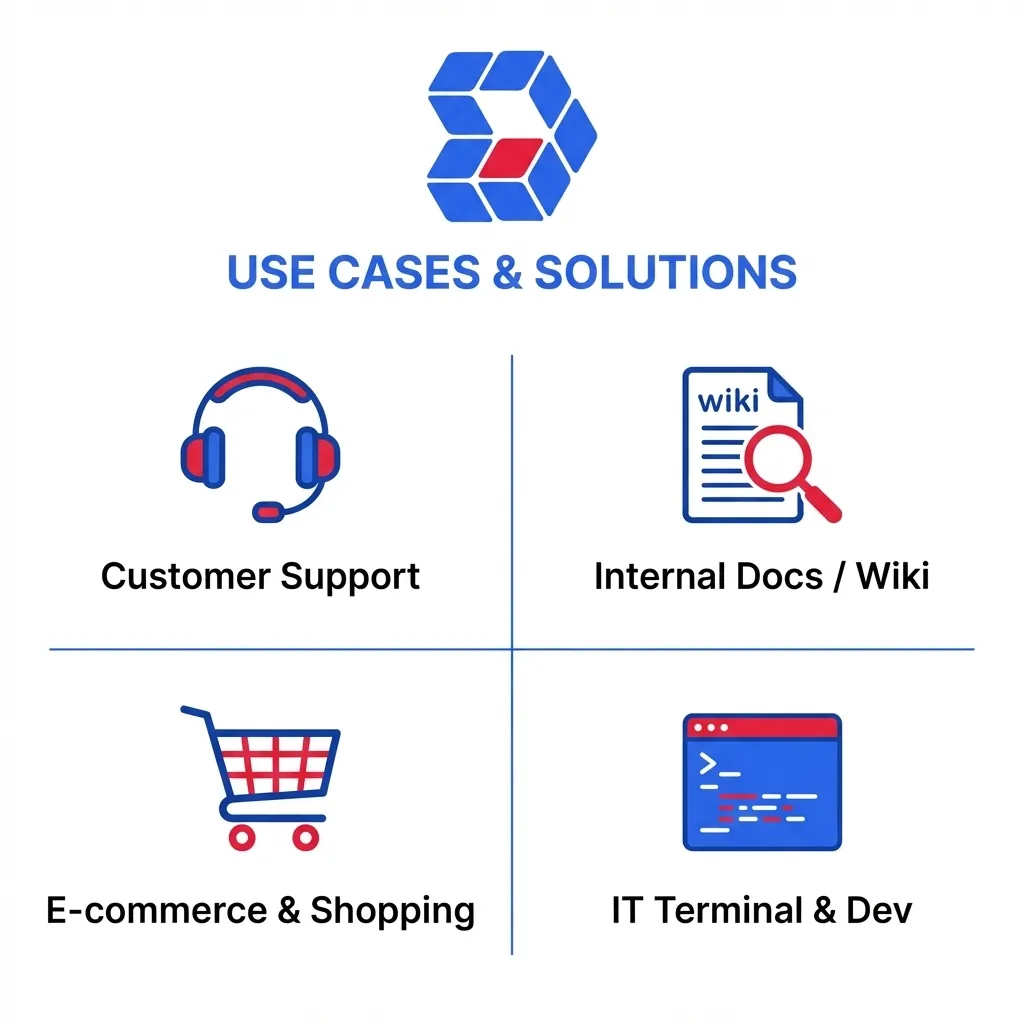
Support teams handle the same questions repeatedly: shipping times, return policies, account setup, billing issues. A RAG chatbot trained on your help center and policy pages resolves these queries instantly, 24/7, with source citations so customers can verify.
When the support team at a mid-size e-commerce company deployed a RAG chatbot across their help center, they saw support ticket volume drop by 40% in the first month. The chatbot handled shipping inquiries, return policy questions, and product compatibility checks without human involvement. The support agents could finally focus on complex issues that actually needed a human touch.
Internal Knowledge Search#
Employees waste hours searching for information buried in wikis, shared drives, and outdated documentation. A RAG chatbot connected to your internal knowledge base lets anyone ask a question in plain language and get the right answer with a link to the source.
E-Commerce Product Discovery#
Shoppers describe what they want in their own words. A RAG chatbot connected to your product catalog can handle queries like "lightweight running shoes for flat feet" and surface the right products, even when the query does not match your product titles or descriptions.
For e-commerce businesses, this directly impacts conversion. Every question answered at the right moment is a sale that might have been lost.
IT Helpdesk and Technical Documentation#
Technical teams maintain sprawling documentation that grows faster than anyone can read. A RAG chatbot indexed on your technical docs gives engineers instant answers to "how do I configure X" or "what are the API limits for Y" without searching through dozens of pages.
Healthcare and Compliance-Heavy Industries#
When accuracy is not optional, RAG provides a safety net. Healthcare organizations use RAG chatbots to surface verified medical information, policy guidelines, and procedure documentation. The source citation feature is critical here, because every answer must be traceable and verifiable.
How to Build a RAG Chatbot#
You have two main paths: no-code platforms for fast deployment, or developer frameworks for custom builds.
No-Code: Build a RAG Chatbot With Denser AI#
For most businesses, a no-code platform is the fastest and most practical path. Here is how it works with Denser AI:
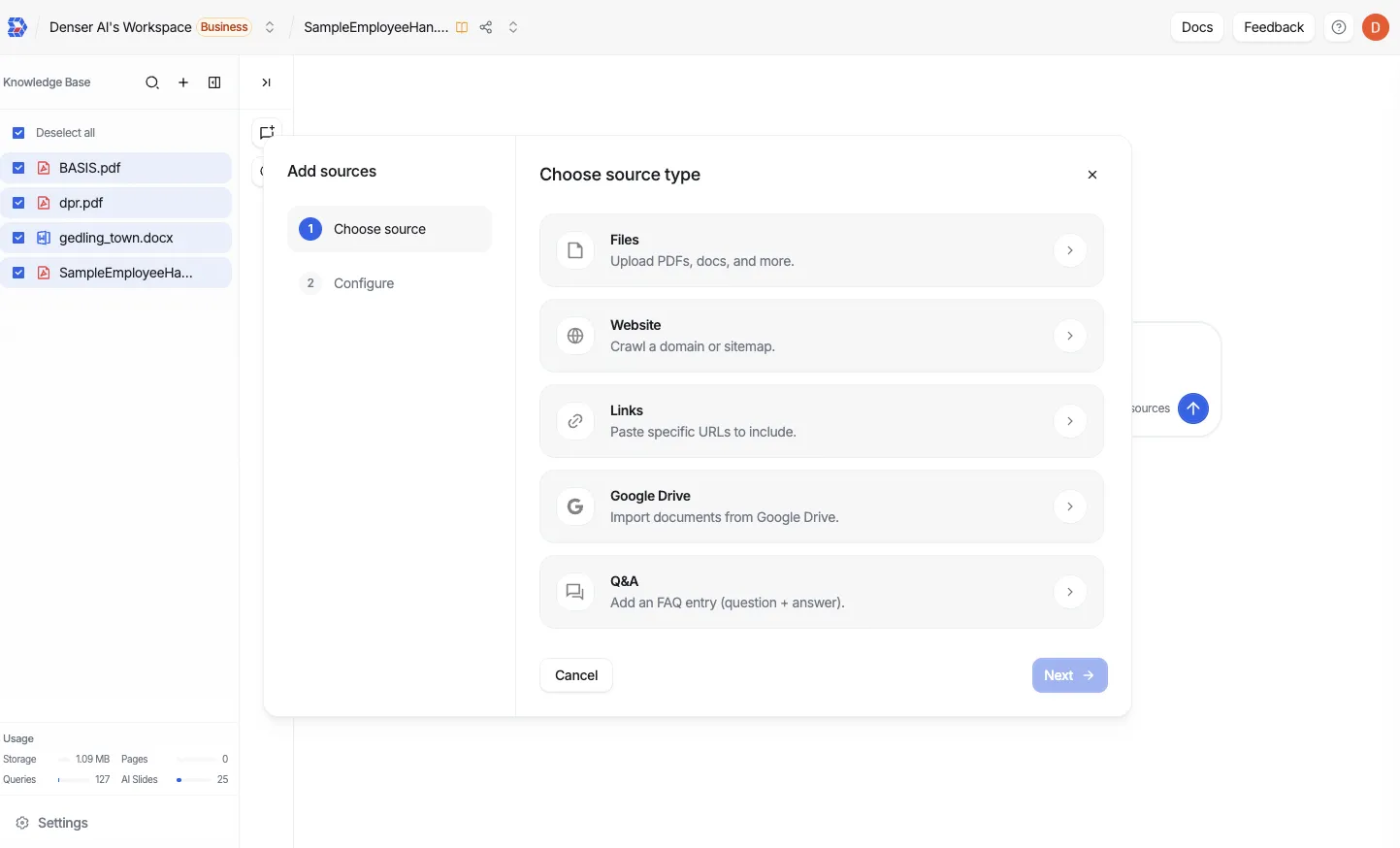
Step 1: Connect your data. Paste your website URL for automatic crawling, upload documents (PDF, DOCX, PPTX), or connect your database. Denser indexes everything automatically.
Step 2: Configure the chatbot. Set the AI's behavior with custom prompts. Choose how it should respond, what tone to use, and when to escalate to a human agent.
Step 3: Deploy. Add the chat widget to your website with one line of code. Or deploy to Slack, Shopify, WordPress, or any platform via the Zapier integration or REST API.
The entire setup takes minutes, not months. And because Denser uses a three-layer search architecture (keyword + semantic + ML reranking), retrieval accuracy is significantly higher than single-method systems.
Lisa, a customer success lead at a B2B software company, had been told building a knowledge base chatbot would take her engineering team 6-8 weeks. Instead, she signed up for Denser AI on a Monday morning, crawled their 400-page documentation site, tested 50 common customer questions by lunch, and had the chatbot live on their help center by Tuesday. The engineering team never had to touch it.
Developer Frameworks: LangChain, LlamaIndex, and Custom Builds#
If you need full control over the retrieval pipeline, embedding models, and infrastructure, developer frameworks like LangChain and LlamaIndex provide the building blocks for custom RAG systems.
This path requires:
- Choosing and managing a vector database (Pinecone, Weaviate, Elasticsearch)
- Selecting embedding models for your content type
- Building the retrieval and reranking pipeline
- Managing hosting, scaling, and monitoring
- Handling document processing (parsing, chunking, indexing)
For teams with ML engineers and specific infrastructure requirements, this approach offers maximum flexibility. For everyone else, a managed platform eliminates months of development work.
How to Choose#
| Factor | No-Code (Denser AI) | Custom Build (LangChain, etc.) |
|---|---|---|
| Time to deploy | Minutes to hours | Weeks to months |
| Technical requirement | None | ML engineering team |
| Infrastructure management | Handled for you | You manage everything |
| Retrieval quality | Three-layer hybrid search | Depends on your implementation |
| Cost | Starting at $19/month | Infrastructure + engineering time |
| Flexibility | High (API available for customization) | Maximum |
For most business use cases, no-code platforms deliver better results faster. If you outgrow the platform, Denser also offers a REST API and Denser Retriever for developers who want managed infrastructure with API-level control.
Build Your RAG Chatbot With Denser AI#
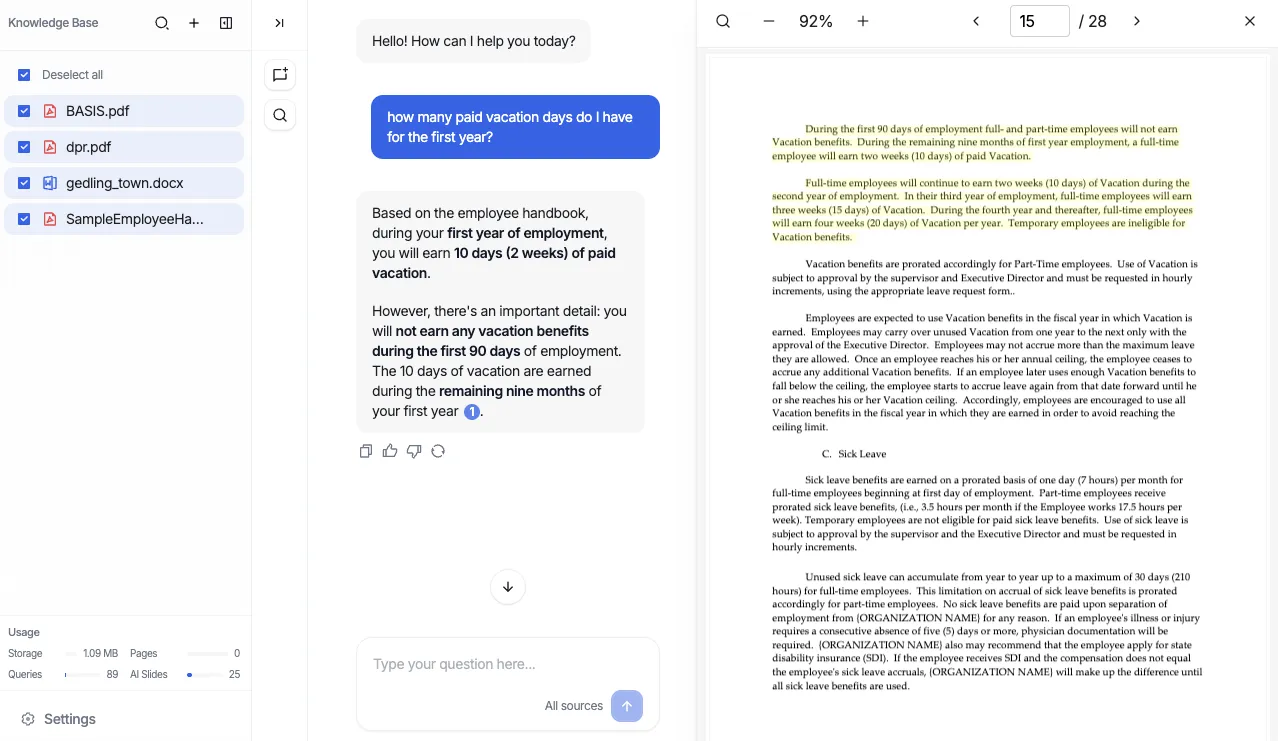
Denser AI is built specifically for RAG-powered chatbots. It combines no-code simplicity with enterprise-grade retrieval accuracy.
Here is what sets it apart:
- Three-layer search: Keyword matching + semantic vector search + ML reranking for the highest retrieval accuracy
- Multi-source indexing: Website crawling (100K+ pages), document uploads, database connections, Google Drive
- Source citations: Every response includes clickable links to the original content
- Human handoff: Automatic escalation to live agents when the bot cannot answer
- Multi-channel deployment: Website widget, Slack, Shopify, WordPress, Zapier, REST API
- Multilingual support: Serve customers in their language without separate bots
Whether you are building a customer support chatbot, an internal knowledge assistant, or an AI-powered search experience, Denser AI gives you the retrieval quality that makes RAG actually work.
Start free today. No credit card required.
FAQs About RAG Chatbots#
What is the difference between RAG and fine-tuning?#
RAG retrieves relevant content from your data at query time and uses it as context for the response. Fine-tuning modifies the language model's weights by training it on your data. RAG is faster to set up, easier to update, and does not require ML expertise. Fine-tuning can be useful for changing the model's style or behavior, but for most business use cases, RAG provides better accuracy with less effort.
How much does a RAG chatbot cost?#
Costs range from free (Denser AI offers a free tier) to hundreds of dollars per month depending on volume and features. No-code platforms typically start at $19-99/month. Custom builds using developer frameworks involve infrastructure costs (vector database, compute, hosting) plus engineering time. For most businesses, a managed platform is significantly more cost-effective than building from scratch.
Can a RAG chatbot handle multiple languages?#
Yes. Because RAG chatbots generate responses using a large language model, they can respond in any language the model supports. The retrieval layer also handles multilingual content, especially when using semantic search that matches meaning rather than exact keywords. Denser AI supports multilingual queries out of the box.
How accurate are RAG chatbot responses?#
Accuracy depends on two factors: the quality of your source content and the quality of the retrieval system. With clean, comprehensive content and a strong retrieval pipeline (hybrid search with reranking), RAG chatbots can resolve 60-80% of customer queries without human intervention. Source citations let users verify every answer.
Do I need coding skills to build a RAG chatbot?#
No. Platforms like Denser AI provide a complete no-code experience. You paste your website URL or upload documents, configure the chatbot's behavior, and deploy with a single line of code or a plugin. No ML knowledge, no vector databases to manage, no infrastructure to maintain.