

What Is Semantic Search? Everything You Need to Know

Semantic search helps search systems understand user intent and meaning. Instead of relying only on exact keyword matches, it looks at user intent and contextual meaning to return more relevant results.
That matters because people rarely search using perfect wording. They ask full questions, use natural language, make typos, and often type vague search queries into a search bar.
This article helps you understand the meaning of semantic search. You will also see how it works and how it differs from traditional search.
TL;DR#
-
Semantic search retrieves information based on meaning and intent, not only keyword matching.
-
It uses query analysis, natural language processing, vector search, and ranking models to improve search results.
-
Businesses use semantic search for site search, e-commerce discovery, help centers, chatbots, and internal knowledge access.
-
Denser AI helps you improve search accuracy with citation-backed semantic search for websites and documents.
What Is Semantic Search?#
Semantic search is designed to match queries to ideas, concepts, and context rather than exact phrasing alone.
A traditional search engine usually looks for exact matches or close variations through keyword matching. Semantic search looks past the wording and focuses on the meaning behind the user's query.
So if someone searches for "revenue growth," a semantic search engine may also surface content about increasing sales or improving pipeline conversion. The wording is different, but the intent is close. That is one of the key differences between semantic and keyword search.
Why Semantic Search Is Relevant Now#
People do not search the way they used to. They ask questions the way they talk, especially in chat interfaces and voice tools.
You can see that in the kinds of queries people type now:
-
"Best running shoes for bad knees"
-
"How do I find our refund policy for annual plans?"
A system built only on traditional keyword-based search will often struggle with that kind of request. If the wording on the page does not line up closely enough, the quality of the result drops fast.
An Illustration of Semantic Search#
Imagine you run an e-commerce store and a visitor types "comfortable shoes for long walks" into the search bar.
Traditional search systems usually rely more heavily on exact matches across product pages. That can work if your catalog uses the same wording. If it does not, the results may be weak even when you sell products that fit the need.
A semantic search engine takes a different approach. It looks at the meaning behind the request and tries to understand what the shopper is really looking for.
In this case, the system may infer that the person wants footwear suited to long-distance walking.
That is why semantic search can return more relevant results even when the exact keyword is missing. It is not just matching words. It is matching intent.
How Does Semantic Search Work?#
Semantic search works by turning language into signals a machine can compare, retrieve, and rank.
At a high level, the system reads the search query, interprets the meaning, finds related content, and ranks the most useful matches near the top. The exact setup varies, but the logic is usually similar.
Query Understanding and Intent#
The process starts with the search query itself. Instead of treating it like a loose bag of keywords, the system tries to understand what the person is asking for.
This is where natural language processing comes in. Natural language processing (NLP) helps the system process human language and infer search intent.
For example, "refund policy for sale items" signals a different need from "buy running shoes size 10." One is informational. The other is transactional. Good semantic search systems catch that early because it shapes what comes next.
Entities, Synonyms, and Context#
Once the system has a rough sense of the query, it starts looking at relationships between words and concepts.
It may identify entities such as product names, brands, or internal business terms. It may also connect related languages, so "annual leave policy" and "vacation policy" can lead to the same destination in an internal knowledge base.
Many semantic search systems also turn words, phrases, or documents into vectors. That is where vector search and similarity search come in. Vector similarity lets the system compare meaning, not just surface wording.
Some setups go further, using knowledge graphs or similar semantic data structures to more clearly connect entities and relationships. In practice, that helps the system understand query context with more depth.
Ranking Results by Meaning#
Finding possible matches is only part of the job. The system still needs to decide which results should appear near the top.
That ranking can account for semantic similarity, topical relevance, metadata, and business rules. In some cases, it may also use contextual search signals such as search history or user preferences.
The goal is to surface the most useful results faster.
Semantic Search vs Keyword Search#
Keyword search and semantic search solve different problems. One looks for term matches. The other tries to understand intent and meaning.
Keyword search still works well when precision matters. If someone searches for an SKU, a product code, or a legal phrase, exact matches are often the right choice.
Semantic search is stronger when people search in natural language or describe a need without knowing the exact wording. That is one of the clearest ways semantic search differs from traditional search.
Lexical search is the broad term for search methods built around token matching and term frequency. Contextual search overlaps with semantic search because both use surrounding meaning, though contextual search may also pull in user context or location.
| Search Method | What It Matches | How It Handles Synonyms | How It Handles Vague Queries | How It Handles Exact Terminology | Best Use Cases |
|---|---|---|---|---|---|
| Keyword search | Exact words and close variations | Usually limited unless you add rules manually | Often weak | Strong | Error codes, exact product names, legal language |
| Semantic search | Meaning, intent, related concepts | Stronger because it can connect related terms | Strong | Can miss precision if overgeneralized | Help centers, ecommerce discovery, internal knowledge search, natural language site search |
In practice, many teams use both. They rely on keyword search for exact matches and semantic search for broader queries where wording varies.
Why Semantic Search Is Important for Your Business#
The main reason semantic search matters is relevance. Users find what they need faster because the system does not force them to guess the exact wording.
That matters on public websites, but it matters even more inside a business. If someone on your team needs the latest process doc or a policy article, they should not have to memorize the file title first.
They should be able to describe what they need in natural language and get relevant results back.
Some of the benefits of semantic search include:
-
Fewer dead-end searches
-
Better search accuracy
-
Faster document retrieval
-
Stronger user satisfaction
From a business standpoint, semantic search creates a more useful search experience. It can also support key performance indicators such as zero-result rate or time to answer.
Limitations of Semantic Search#
Semantic search improves relevance, but it still has limitations. It can miss precision and overgeneralize, especially when the underlying data is weak.
Dependency on High-Quality Data#
Semantic search depends on the quality of the content it indexes. If your documents are outdated, thin, mislabeled, or inconsistent, the system has less to work with.
Better retrieval still depends on better source material.
Over-Generalization#
A meaning-based system can return results that are related without being fully right. Someone searching for a narrow policy exception may get a broader policy page instead.
That is one reason exact matches still matter in some workflows.
Context and Domain Limits#
Industry language creates another challenge. A general semantic search solution may understand common business terms but still miss domain-specific jargon or product naming.
That is especially true when the system has not been tuned on the language your team uses every day. Search accuracy depends heavily on the domain context.
Computational Intensity and Cost#
Semantic search systems are also heavier to run than simple keyword lookup. They often rely on embedding models, machine learning models, and vector indexes.
From a technical standpoint, a full semantic search implementation is usually more demanding than a basic keyword system.
Applications of Semantic Search#
Semantic search shows up anywhere people need to find information without knowing the exact wording.
Search engines use it to interpret broad questions and conversational phrasing. Ecommerce teams use it to improve product discovery when shoppers describe a need instead of using catalog terms.
On websites and help centers, semantic search helps visitors find answers to questions like "refund policy for sale items" or "can I cancel before renewal." That same retrieval layer also powers many website chatbots, which need semantic understanding before they can return the right answer.
Inside a business, the value is often even clearer. Teams use semantic search for internal handbooks, HR policies, technical documentation, and support workflows.
Instead of digging through folders, staff can search for "annual leave policy" or "enterprise pricing page" and pull up the right source quickly.
How to Optimize Content for Semantic Search#
You do not optimize for semantic search by repeating the same phrase over and over. You optimize by making meaning easier to interpret.
Write for Topics and Intent#
Start with the problem behind the search query. What is the reader or searcher actually trying to do?
A page targeting "what is semantic search" should explain the concept clearly, show how semantic search works in practice, and connect it to real use cases. That gives search systems the context they need while also helping the reader.
Answer Real Questions Clearly#
Cover the natural questions around the topic. That includes definitions, limitations, and business examples.
Use related entities and consistent terminology so the page gives semantic search systems enough context to understand its depth. If a page mentions retrieval-augmented generation (RAG), link to "what is RAG" instead of dropping the term without explanation.
Make Structure and Context Easy to Read#
Use descriptive headings, clear section breaks, and direct language. Schema can help where it fits, especially for FAQs.
Consistency matters too. If you call something "site search" in one paragraph and "discovery engine" in the next for no reason, you make interpretation harder. If you want a stronger search experience, this guide to an AI-powered search experience is worth bookmarking.
Relationship Between Semantic Search, AI Search, and RAG#
Semantic search is one of the building blocks behind modern AI search. It helps the system retrieve relevant material before an answer is generated.
AI search goes a step further. Instead of only returning links, it may summarize or generate an answer in natural language. For that to work well, the retrieval layer still needs to be strong.
Without that grounding, the system may sound confident while pulling from the wrong source. That is why retrieval augmented generation matters here.
Retrieval augmented generation means the AI first retrieves relevant source material, then uses that material to help produce the answer.
Semantic search often handles the retrieval side by finding the right documents or passages through vector similarity and semantic understanding.
Improve Search Quality With Denser AI#
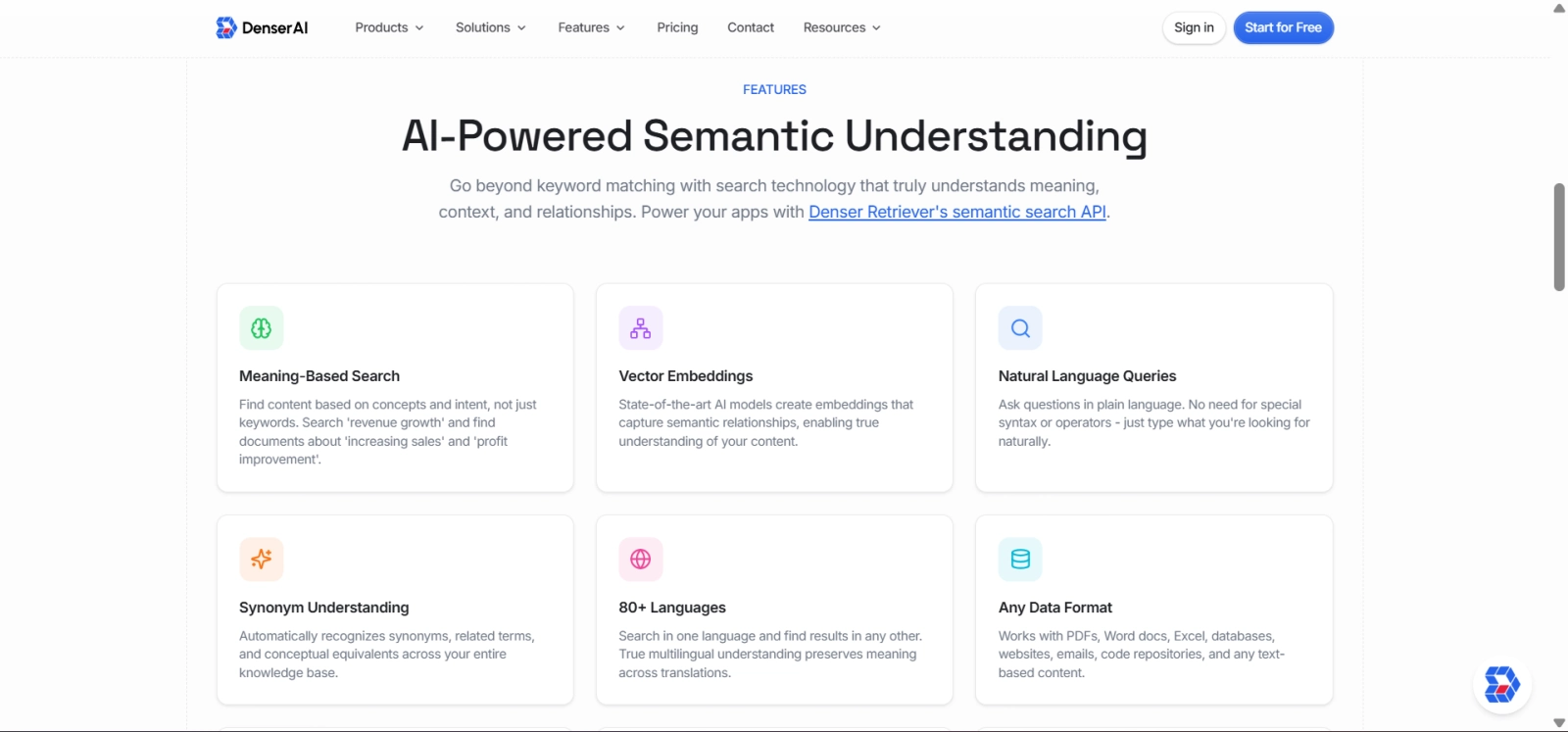
Denser AI helps you turn your content into a search experience that understands intent, not just matching terms. Instead of forcing users to guess the exact wording, it helps them find relevant answers across your website, documents, and business data with less friction.
You can launch semantic search without a heavy setup process, give users citation-backed answers they can verify, and make it easier for teams or customers to get to the right information faster.
Try Denser AI today if you want a practical way to improve semantic search and content discovery.
FAQs About What Is Semantic Search#
Is semantic search the same as vector search?#
No. Vector search is one method used in many semantic search systems. It helps compare the meaning of queries and documents through numerical representations. Semantic search is the broader outcome.
Does Google use semantic search?#
Google uses many meaning-based systems to interpret language, intent, and entity relationships. The exact stack changes over time, but modern search engines clearly go beyond exact keyword matching.
How do you optimize content for semantic search?#
Write around intent, related questions, entities, and topical depth. Use clear headings, consistent terminology, and internal links that connect closely related concepts. Avoid thin pages that only repeat one keyword.
How does semantic search help internal knowledge search?#
It helps employees find policies, docs, and answers even when they do not know the exact file name or wording. A person can search "annual leave policy" and still surface a document titled "vacation rules," which makes internal knowledge retrieval faster and less frustrating.