

Chatbot Automation in 2026: From FAQ Bots to Agentic AI

Chatbots have changed more in the past two years than in the previous ten.
What used to be a scripted FAQ widget is now a spectrum --- from keyword matching, to retrieval-based knowledge bots, to AI agents that look up orders, change subscriptions, and complete tasks on a customer's behalf.
The hard part isn't whether to deploy a chatbot --- it's deciding which kind. This guide walks through the three stages of chatbot automation in 2026 --- FAQ bot, RAG chatbot, and agentic AI --- and where each one actually fits.
The Three Stages at a Glance#
Stage 1: FAQ Bot Stage 2: RAG Chatbot Stage 3: Agentic AI
Core mechanism Keyword / intent matching Retrieval + LLM generation LLM + tool calling + planning
Knowledge source Hardcoded rules & scripts Indexed documents & databases Dynamic data + external APIs
Answer quality Exact match or fallback Contextual, cited answers Task completion, not just answers
Handles ambiguity Poorly Well Well, follows up if unclear
Can take actions No Limited (handoff only) Yes --- books, queries, updates
Setup complexity Low Medium High
Best for High-volume FAQ deflection Knowledge Q&A + support Multi-step workflows
Stage 1: FAQ Bots#
The FAQ bot is the original chatbot model. It matches incoming messages to a predefined intent list using keyword detection or simple classifiers, returns a scripted response when a match is found, and falls back to a default message or human escalation when it doesn't.
This works well for high-volume, low-variation questions where one answer never changes --- hours, return policies, shipping destinations.
The scripted nature is a compliance feature in regulated industries where every customer-facing word needs approval.
Operational overhead is near zero --- no model to tune, no embeddings to manage.
The ceiling shows up the moment a customer phrases something differently or asks a follow-up:
Customer: Hi, can I return something I bought last week?
FAQ Bot: Our return policy allows returns within 30 days of purchase. Please visit our returns portal to initiate your return.
Customer: It was a sale item though --- does that change anything?
FAQ Bot: I'm sorry, I didn't understand that. Would you like to speak with a customer service agent?
The first reply was correct. The follow-up --- a natural, reasonable clarification --- fell outside the training set. That's the boundary of the FAQ model.
Stage 2: RAG Chatbots#
The RAG (Retrieval-Augmented Generation) chatbot is the current production standard for AI customer service. Instead of matching keywords to scripted responses, it retrieves relevant content from a knowledge base and uses a language model to generate a contextual answer --- with citations to the sources it drew from.
The architectural shift matters: the bot no longer needs to anticipate every possible question. Index your documentation, policies, and product data once, and it answers anything that can be answered from those sources --- in the customer's own words, with a citation to verify.
The trade-off is that a RAG chatbot answers questions but doesn't take actions. It can tell a customer how to initiate a return; it can't initiate the return for them. That's Stage 3.
Denser AI at Stage 2#
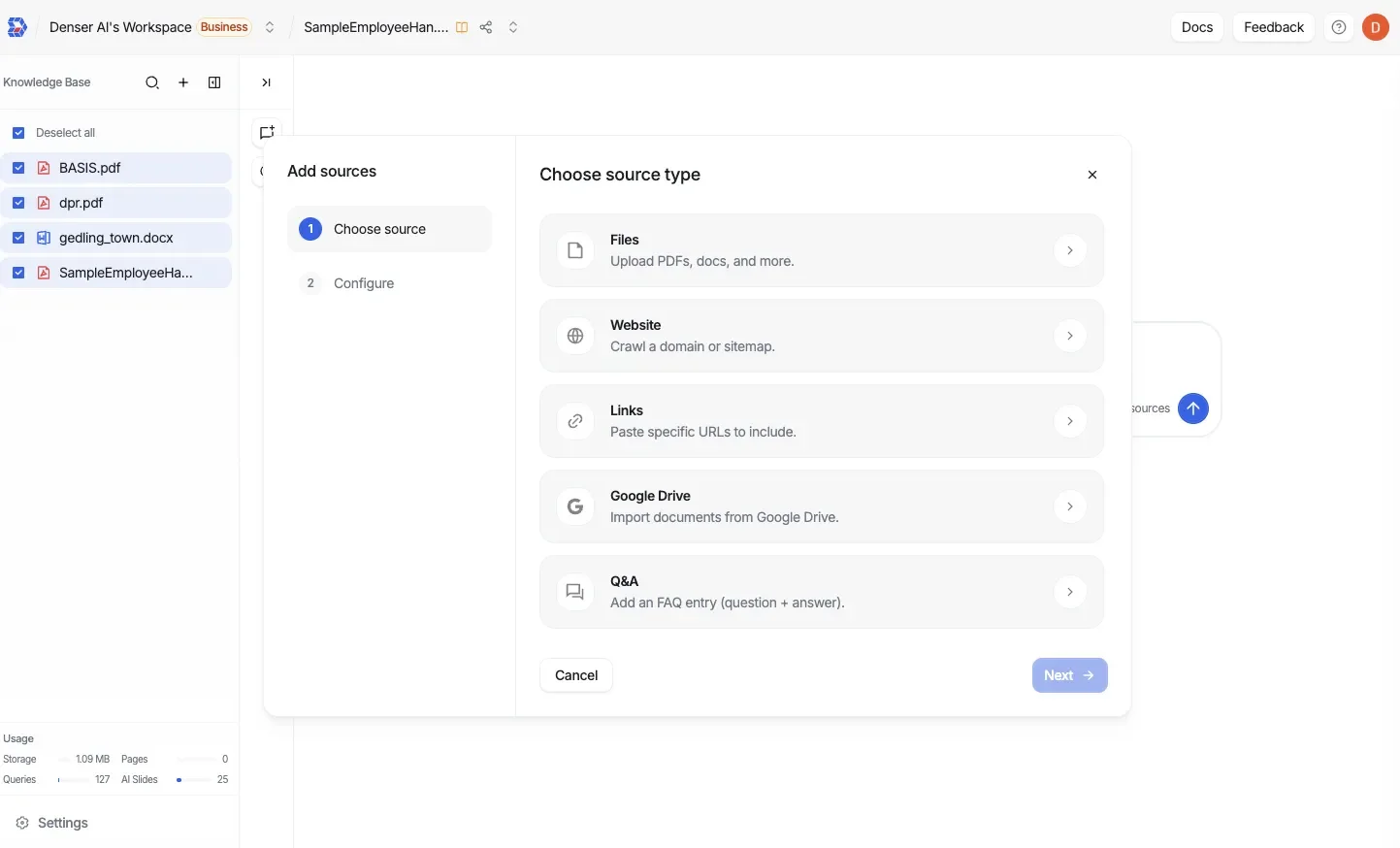
Denser AI's RAG chatbot runs a three-layer retrieval pipeline --- keyword matching, vector search, and re-ranking --- across websites, PDFs, and databases simultaneously.
The chatbot deploys on a website, embeds in a Shopify store, or connects via REST API, and indexes new content automatically when source material is updated.
Every response includes paragraph-level source citations, so customers can verify the answer and support managers can audit accuracy.
For most businesses, Stage 2 delivers the best ROI on chatbot investment --- and it's the right foundation before adding any agentic capabilities.
Stage 3: Agentic AI#
Agentic AI represents a fundamental shift. A FAQ bot matches questions to answers. A RAG chatbot generates contextual responses.
An AI agent executes tasks --- calling APIs, querying databases, making decisions, taking actions across multiple steps to complete a goal.
The distinction is clearest when the same request goes to all three stages:
Customer Request FAQ Bot RAG Chatbot Agentic AI
"Cancel my subscription" Links to cancellation page Explains cancellation process Cancels, confirms, sends email
"Book a demo for next Tuesday" Links to calendar Explains how to book Checks availability, books, invites
"Why is my order late?" Returns tracking FAQ Explains what delays typically mean Queries order system, gives ETA
"Upgrade my plan" Links to pricing page Compares plan features from docs Checks account, processes upgrade
An AI agent combines three capabilities: tool use (calling APIs, querying databases, triggering workflows), planning (breaking a goal into ordered steps), and decision-making (handling conditional logic --- pause instead of cancel if there's an active promotion).
A Typical Agentic AI Conversation#
Customer: I want to cancel my subscription.
Agent: Got it. I can see your Standard plan renewing on June 15th --- and you have $24 in unused credits that would be forfeited on cancellation.
Would you like to apply them first, or downgrade to Free instead?
Customer: Downgrade to Free.
Agent: Done. Credits applied, plan downgraded effective June 15th. Confirmation sent to your email.
The agent queried an account database, identified a retention opportunity, applied credits, processed a plan change, and sent a confirmation --- in one conversation, without human involvement.
Where Agentic AI Is Production-Ready Today#
-
Subscription management: Cancellation, upgrades, downgrades, pauses
-
Order management: Status checks, address changes, eligible cancellations
-
Meeting and demo booking: Availability, booking, and confirmation
-
Tier-1 IT helpdesk: Password resets, account unlocks, software provisioning
-
Lead qualification: Gather details and route to the right rep
Denser AI at Stage 3#
Denser AI's agentic capabilities extend the RAG foundation with tool-use support --- the chatbot can query live databases, connect to order management systems, and take actions based on retrieved data.
This is what separates a bot that explains your return policy from one that initiates the return.
For ecommerce teams, this means workflows that go beyond answering questions to processing requests, applying credits, and updating records in connected systems.
What to Build in 2026#
The most common mistake teams make is trying to jump to Stage 3 before Stage 2 is working. Agentic AI is powerful, but it requires reliable retrieval and a well-indexed knowledge base underneath.
A practical sequence:
Start with RAG for your knowledge base.
Index your documentation, policies, and product content. Get accurate, cited answers working. This alone deflects most support volume.
Identify your highest-volume transactional requests.
Look at what human agents spend most time on after knowledge questions are handled. Those are your Stage 3 candidates.
Add agentic capabilities incrementally.
Start with one well-defined task type --- order status, subscription management, booking --- before expanding.
Keep the human-handoff path clear.
Every automation layer should escalate cleanly, with full context passed along.
In practice, mature deployments layer all three stages --- FAQ for the highest-volume predictable questions, RAG for anything that needs understanding, agents for transactional tasks --- with human handoff for cases that genuinely need judgment:
Query Type Resolved At
Simple policy question Stage 1 (FAQ)
Complex policy question Stage 2 (RAG)
Product comparison Stage 2 (RAG)
Order status inquiry Stage 3 (Agent)
Subscription change Stage 3 (Agent)
Fraud dispute / complaint Human agent
High-value sales inquiry Human agent
Where to Start#
The right place to begin is with the knowledge your customers are already asking about --- index it, make it retrievable, make it cited. That's the foundation everything else builds on.
Denser AI is built to support that foundation and grow with it as automation requirements increase.
Start building at denser.ai.
Common Questions About Chatbot Automation with Denser AI#
Q1: What's the practical difference between an FAQ bot and a RAG chatbot?
An FAQ bot returns pre-written answers matched to known intents. A RAG chatbot reads your actual documentation and generates cited answers --- even for questions no one scripted. Denser AI's RAG pipeline handles the edge cases an FAQ bot falls back on.
Q2: When does it make sense to move from RAG to agentic AI?
When your top support requests are tasks, not questions --- order lookups, cancellations, demo bookings. If there's a defined resolution path, it's a Stage 3 candidate.
Q3: How does Denser AI handle retrieval?
Three-layer approach --- keyword search, vector search, and re-ranking --- across websites, PDFs, and databases simultaneously. Every answer includes a paragraph-level source citation.
Q4: Do I need to retrain Denser AI when documentation changes?
Answers update automatically at the next indexing run --- no retraining cycle. Accuracy stays current even when policies or product details change frequently.
Q5: What's a realistic first step for a team that's never deployed a chatbot?
Index your existing help center articles and policy pages, then deploy a RAG chatbot for inbound knowledge questions. Start directly at denser.ai.
Q6: Does Denser AI handle multiple languages?
Yes --- auto-detects language from the first message and replies in kind, across 80+ languages. One knowledge base serves every market.
Q7: What data sources can Denser AI connect to?
Websites (paste a URL for automatic crawling), documents (PDF, Word, Excel, Markdown, and more), and databases via REST API. All sources index into the same project and return unified results.