

AI Agents Examples: 15 Real-World Use Cases Reshaping Business in 2026

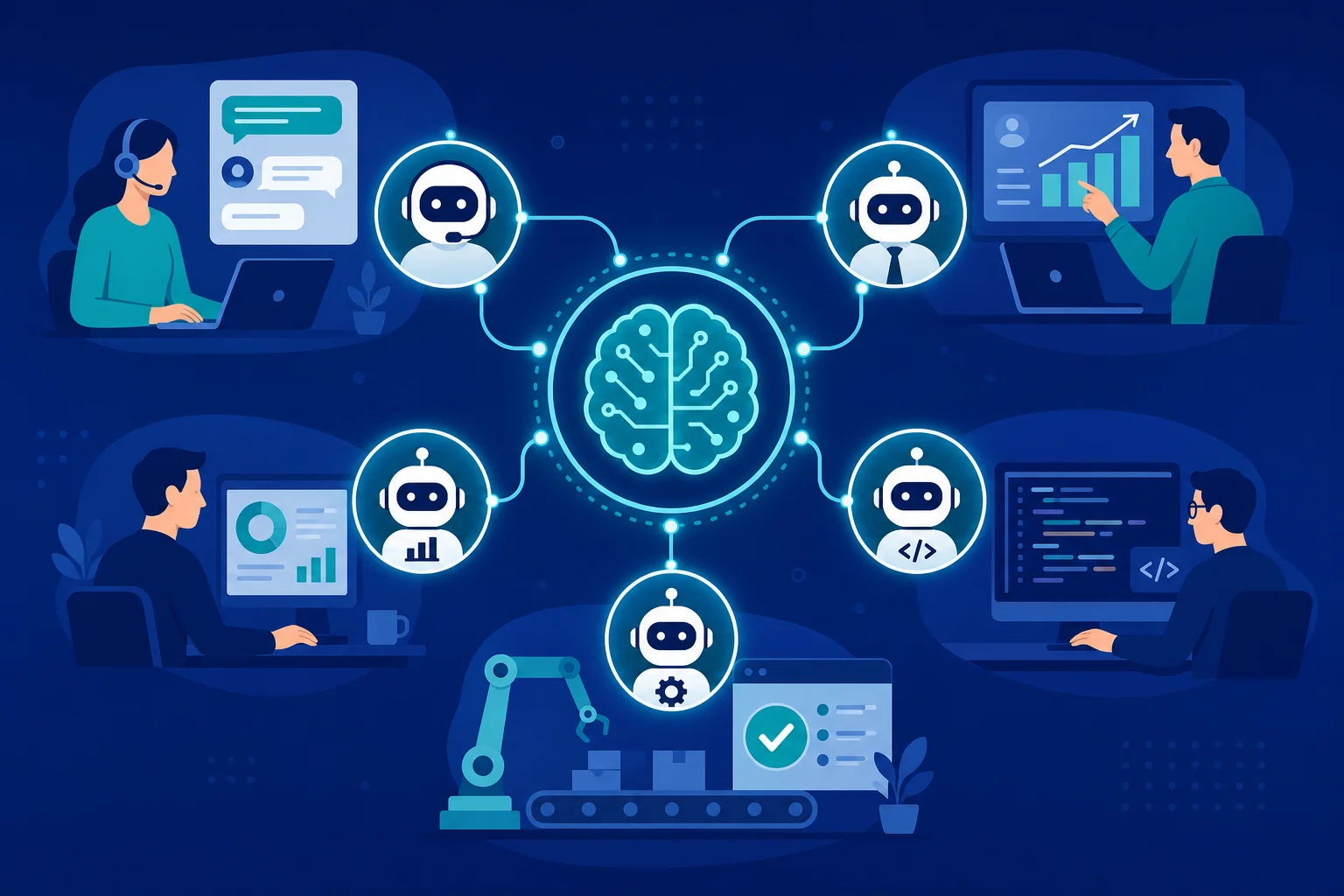
AI agents are autonomous systems that perceive their environment, reason about what to do, take actions through external tools, and learn from results — all without a human directing every step. Unlike a chatbot that simply responds to messages, an agent picks up a goal, breaks it into sub-tasks, calls APIs and databases, evaluates what comes back, and decides the next move until the objective is met.
If you're trying to understand what AI agents look like in practice — not in theory — this guide walks through 15 real-world examples across industries, the five types of agents you should know, how the architecture works under the hood, and the hard challenges that separate working deployments from the 95% of pilots that fail.
For a focused production example, see how an AI agent for customer support retrieves cited answers, takes approved actions, and transfers complex requests to a human with context.
Key Takeaways#
- AI agents ≠ chatbots. Agents act autonomously across multiple steps; chatbots respond one turn at a time. The distinction matters for deployment, governance, and ROI.
- Real deployments are already live. Klarna handled 2.3 million conversations in one month; OpenTable resolved 70% of inquiries autonomously; GitHub Copilot writes code and opens pull requests.
- The market is large and growing fast — $7.63 billion in 2025, projected to reach $50+ billion by 2030 at a ~46% CAGR.
- Most projects fail. Gartner predicts 40%+ of agentic AI projects will be canceled by end of 2027. Only 25% of AI initiatives deliver expected ROI.
- The biggest differentiator in production agents is retrieval accuracy. Systems that ground every answer in cited source material — rather than free-generating from a model's training data — dramatically reduce hallucinations and build user trust.
What Is an AI Agent? (And What It Isn't)#
An AI agent is an autonomous system that makes decisions, takes action, and resolves complex issues without human intervention. The key word is autonomous: you give an agent a goal, and it figures out the steps.
"Agentic AI is AI that acts, not just answers. A standard language model responds to a prompt and stops. An agentic system takes a goal, breaks it into steps, calls tools (APIs, databases, sensors), evaluates what came back, and decides what to do next." — Opsima
AI Agent vs. Chatbot vs. AI Assistant#
| Dimension | Traditional Chatbot | AI Assistant | AI Agent |
|---|---|---|---|
| Trigger | User sends a message | User issues a command | A goal or condition activates a reasoning loop |
| Decision-making | Predefined scripts/decision trees | Adapts to user preferences | Evaluates context and chooses next action autonomously |
| Tool use | None or single API | Limited integrations | Orchestrates multiple tools, APIs, data sources |
| Memory | Stateless | Session-based | Persistent: retains context across steps and sessions |
| Off-pattern situations | Fails or escalates to human | Falls back to suggestions | Adapts, re-plans, routes only genuine exceptions to humans |
| Human oversight | Required at every step | Required at every step | By exception: humans review outcomes, not each step |
Microsoft puts it bluntly: "AI agents and AI chatbots are fundamentally different technologies."
The practical takeaway: if your system can only respond to messages one at a time, it's a chatbot. If it can pick up a goal like "process this refund request end-to-end" and execute multiple steps — checking the order database, verifying the return policy, issuing the refund, and sending a confirmation — that's an agent.
How AI Agents Work: The Perceive–Reason–Act–Learn Loop#
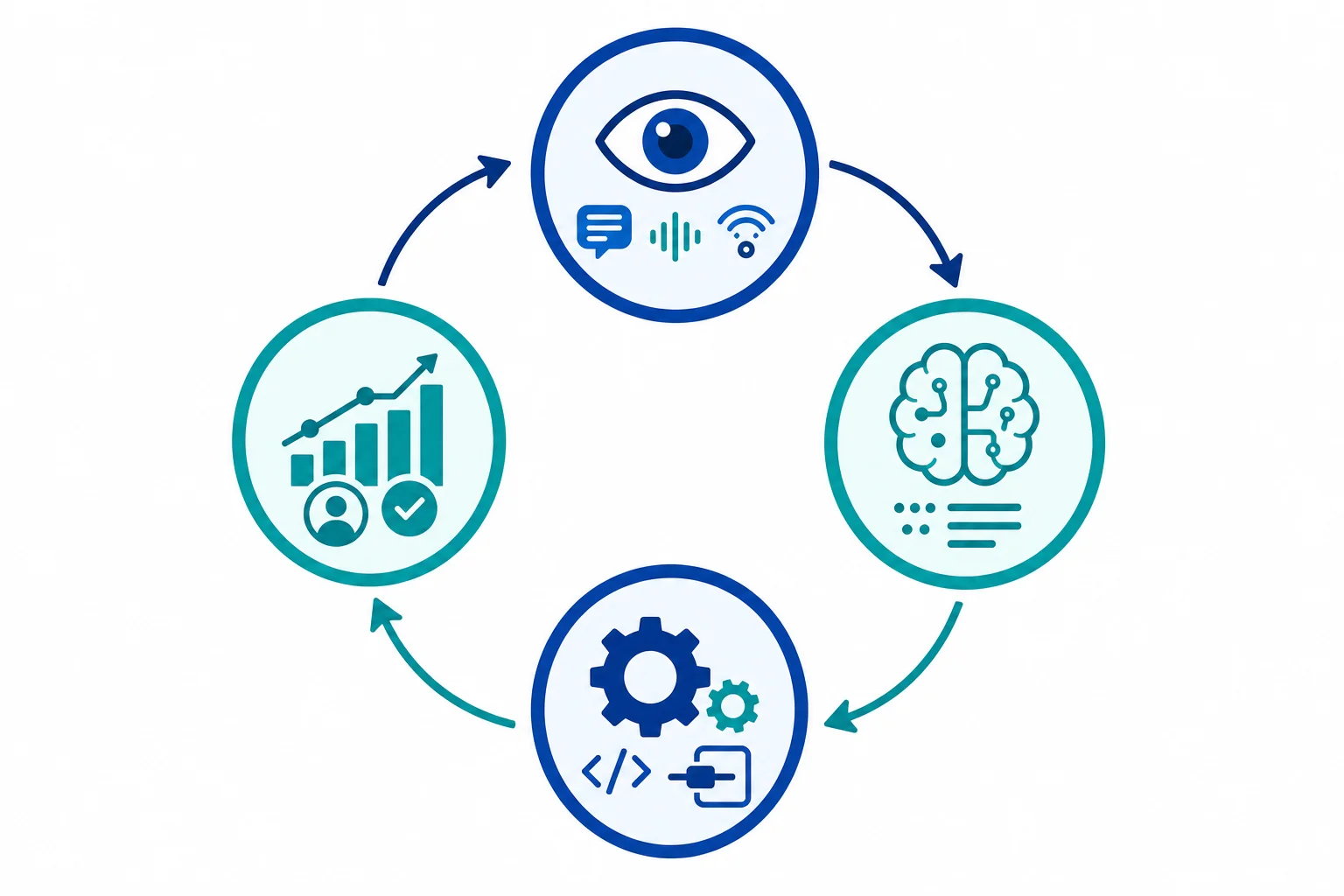
Every AI agent — regardless of industry or complexity — operates through an iterative four-stage loop. Understanding this loop is essential for evaluating whether a vendor's "agent" is actually agentic or just a rebranded chatbot.
1. Perception (Sensing the Environment)#
The agent's sensory interface with the external world. It handles multimodal data: text, audio, sensor input, visual feeds. A customer service agent perceives incoming chat messages and CRM data; a logistics agent perceives GPS telemetry and warehouse inventory feeds; a coding agent perceives GitHub issues and repository state.
"AI agent perception refers to an AI agent's ability to gather, interpret and process data from its environment to make informed decisions." — IBM
2. Reasoning (The Cognitive Core)#
This is where the LLM earns its keep. The reasoning module processes perceptions to decide what to do — but the LLM is one component inside the agent, not the agent itself. Submodules include knowledge retrieval (accessing relevant information to inform decisions), planning (sequencing actions), and decision-making (selecting the best next step).
The most common reasoning pattern is the ReAct cycle (Reasoning + Acting), developed by researchers at Princeton and Google. In each iteration, the agent thinks about the current state, takes an action, and observes the result before thinking again.
3. Action (Executing Decisions)#
The agent executes its selected decision by calling tools, APIs, databases, and communication channels. This is what separates agents from chatbots: the chatbot responds with text; the agent executes real actions in external systems.
"The LLM doesn't store data or execute code by itself: it reasons about what to do and in what order. This mechanism is what differentiates an AI agent from a chatbot." — GuruSup
4. Learning (Adaptation)#
When execution results feed back into the reasoning system, the agent achieves adaptive intelligence that improves with experience. This includes meta-reasoning — agents reflecting on and improving their own reasoning processes.
The 5 Types of AI Agents#
IBM classifies AI agents into five main types based on intelligence level and decision-making complexity.
1. Simple Reflex Agents#
The most basic type. They follow predefined condition-action rules (if X, then Y) with no memory and no planning. Think of a thermostat that turns on the heater when temperature drops below a threshold. Effective in structured, predictable environments — but they break in dynamic scenarios.
Example: An automatic email filter that routes messages to spam if they contain specific keywords.
2. Model-Based Reflex Agents#
These still use condition-action rules but maintain an internal model of the world. They track current state and understand how past interactions affected the environment, allowing them to function in partially observable environments.
Example: A robot navigating a room that considers previous movements and obstacles it has already encountered.
3. Goal-Based Agents#
Instead of just following rules, these agents plan sequences of actions to achieve specific goals. They can evaluate different paths to a goal and select the best one. Most AI systems in production today are goal-based.
Example: A logistics agent that plans the most efficient delivery route to get a package from warehouse to customer by a deadline.
4. Utility-Based Agents#
These extend goal-based agents by evaluating which action maximizes "utility" — a measure of satisfaction or preference. When multiple goals conflict, utility-based agents choose the action that produces the best overall outcome.
Example: A navigation system that considers shortest distance, least traffic, fuel efficiency, and toll costs to recommend the optimal route.
5. Learning Agents#
The most advanced type. Learning agents improve from experience over time — starting with limited knowledge, incorporating feedback, and gradually improving performance through reinforcement learning and other mechanisms.
Example: A customer service agent that learns which response styles lead to higher satisfaction scores and adjusts its approach over time.
Multi-Agent Systems#
Beyond these five types, multi-agent systems coordinate multiple specialized agents — each handling the part of the task for which it is best suited — working together toward a shared goal. Databricks notes that "the most successful production agents in 2026 are hybrids, combining reflexes for safety, planning for flexibility, and limited learning for adaptation."
15 Real-World AI Agent Examples Across Industries#
The following examples are drawn from documented production deployments, press releases, and engineering blogs — not hypothetical scenarios.
Customer Service#
1. Klarna AI Assistant — The Scale Story (and the Reversal)#
Klarna's AI assistant handled end-to-end customer service for the buy-now-pay-later platform across 23 markets in over 35 languages. In its first month, it managed 2.3 million conversations — equivalent to the workload of 700 full-time agents.
But the story didn't end there. Klarna later redeployed human agents after service quality and customer satisfaction dropped, and business growth took a hit. It's now the defining cautionary tale about over-automation: agents can handle volume, but without grounding in accurate, up-to-date source material and quality monitoring, they erode the customer experience.
2. Salesforce Agentforce at OpenTable — 70% Autonomous Resolution#
OpenTable deployed a Salesforce Agentforce-based agent for diner and restaurant inquiries. Within weeks, it resolved 70% of questions autonomously — a marked improvement over their previous chatbot.
George Pokorny, OpenTable's SVP of Global Customer Success: "Within weeks, our restaurant agent handled 70% of questions, a marked improvement over our previous chatbot."
3. Salesforce's Own Internal Deployment — 4,000 Jobs Replaced#
Marc Benioff revealed that Salesforce used AI agents to cut its support staff from 9,000 to 5,000 — eliminating 4,000 jobs as AI assumed 30–50% of the workload. This is one of the most aggressive internal agent deployments on record.
Software Development#
4. GitHub Copilot Coding Agent — From Issue to Pull Request#
Launched in May 2025, GitHub Copilot's coding agent acts on assigned GitHub issues end-to-end. It spins up a secure development environment, clones the repo, writes code, runs tests, and opens a draft pull request for human review. It works inside branch protection and required-review gates — exactly like a human engineer would.
5. Cursor — Autonomous Coding Assistant#
Cursor has become one of the most widely adopted AI coding agents, working alongside developers to understand entire codebases, make multi-file edits, and run commands autonomously.
IT and Internal Engineering#
6. Uber Genie — Agentic RAG for Engineering Support#
Uber's internal LLM-powered Slack bot answers engineering questions about security and privacy policy. The team moved from traditional RAG to enhanced agentic RAG, which increased acceptable answers by 27% and reduced incorrect advice by 60%.
The improvement came from multi-step research: the agent expands the query, retrieves across multiple sources, reflects on whether the response covers the question adequately, and re-queries until a confidence threshold is met.
E-commerce and Retail#
7. Shopify Sidekick — From Tool-Caller to Agentic Platform#
Shopify Sidekick is embedded in the merchant admin and has evolved from a simple tool-calling system into a sophisticated agentic platform. It handles open-ended requests like "show me my best month this year and write a campaign brief targeting those buyers" — analyzing customer segments, filling product forms, and writing SEO descriptions.
Financial Services#
8. JPMorganChase LLM Suite — 200,000 Users in 8 Months#
JPMorganChase built an internal platform giving employees secure access to LLMs for drafting and idea generation. It went from zero to 200,000 onboarded users within eight months, governed from the start inside the bank's security boundary with full audit trails. The next phase: agents executing multi-step workflows against the bank's internal data.
9. BNY Eliza — 125+ Use Cases, 20,000 Employees Building Agents#
BNY's internal AI platform supports 125+ live use cases with 20,000 employees actively building agents. It covers legal review, client research, and operations. BNY's Chief Data and AI Officer: "We're not building side projects. We're changing how the bank works."
Logistics#
10. DHL Supply Chain on HappyRobot — Voice and Email Agents#
DHL deployed voice and email AI agents across regions to handle appointment scheduling, driver follow-up calls, and high-priority warehouse coordination. The agents "autonomously handle phone and email interactions, enabling faster, more consistent, and scalable communication."
Industrial and Manufacturing#
11. Siemens Fuse EDA — Autonomous Semiconductor Design Agent#
Introduced in March 2026, Siemens' Fuse EDA AI agent is purpose-built for semiconductor, 3D IC, and PCB design. It "plans and orchestrates multi-tool and multi-agent complex semiconductor, 3D IC and printed circuit board system workflows that span across design, verification and manufacturing sign-off."
12. ClickUp — 3,000 AI Agents Replace Hundreds of Roles#
ClickUp replaced hundreds of employees with 3,000 AI agents handling tasks across their operations — one of the most aggressive agent-to-human ratios in the SaaS industry.
Port Operations#
13. PNCT (Port Newark) — +5% Fleet Availability#
PNCT deployed an EquipmentOS agent that monitors a fleet of 100+ straddle carriers, achieving +5% fleet availability and ~15% fewer breakdowns through predictive maintenance and autonomous coordination.
Healthcare#
14. Clinical and Administrative AI Agents#
AI agents in healthcare are being deployed for clinical summarization, patient scheduling, claims processing, and easing administrative burden. Kore.ai documents 12 real-world use cases spanning provider workflows, patient engagement, and core business processes — including fast and accurate medical decision support and claims automation.
HR#
15. AI Agents for Human Resources#
Salesforce documents HR agents that act as autonomous digital assistants: an employee asks for time off → the agent checks the leave balance, verifies policy, and submits the request to the manager. Use cases span onboarding, training, compliance, benefits questions, policy interpretation, and performance guidance.
AI Agent Frameworks and Platforms#
If you're building agents rather than buying them, here are the frameworks and platforms defining the landscape in 2026. (Weighing which model to build on? See our Claude vs ChatGPT vs Gemini comparison.)
Top Open-Source Frameworks#
| Framework | Best For | Key Strength |
|---|---|---|
| LangChain / LangGraph | Flexibility, complex custom workflows | Broadest ecosystem; graph-based agent control |
| CrewAI | Role-based multi-agent teams | Low-code friendly; async crew runner |
| Microsoft AutoGen | Complex multi-agent conversations | Event-driven architecture; dynamic agent dialogues |
| OpenAI Agents SDK | OpenAI-native agent building | Planning module (released Feb 2026) |
| LlamaIndex | RAG-heavy applications | Optimized document indexing and retrieval |
| Anthropic Claude Agent SDK | Claude-native agent building | Memory API beta (released Feb 2026) |
| Langflow | Visual prototyping | Python components with visual builder |
| AutoGPT | Experimental autonomous agents | One of the earliest open-source frameworks |
Enterprise Agent Platforms#
For teams that prefer configured platforms over code:
- Salesforce Agentforce — enterprise AI agent platform (powers OpenTable and others)
- ServiceNow AI Agents — workflow-integrated agents for IT and operations
- Google Cloud Vertex AI Agent Builder — Google Cloud-native agent deployment
- Microsoft Copilot Studio — Microsoft 365-integrated agent building
- AWS Bedrock Agents — AWS-native managed agent service
- Boomi Agentstudio — build, govern, and orchestrate agents with low-code
The Build-vs-Buy Decision#
"Choosing an AI agent framework in 2025 is less about picking the 'best' tool and more about aligning trade-offs with your team's constraints: the systems you need to integrate, the governance you must meet, how quickly you need working value, and how deeply you want to customize." — Langflow
For most businesses — especially those deploying customer-facing chatbots or internal knowledge assistants — a no-code platform that handles retrieval, citations, and deployment is a faster path to value than building from a framework.
The Market in Numbers: AI Agent Statistics#
Market Size and Growth#
| Metric | Value | Source |
|---|---|---|
| Global AI agents market (2025) | $7.63 billion | Grand View Research |
| Projected by 2030 | $50.31 billion (CAGR 45.8%) | Grand View Research |
| Enterprise agentic AI by 2030 | $24.50 billion (CAGR 46.2%) | Grand View Research |
| AI agents market (2026) | $10.91 billion | Ringly.io |
Enterprise Adoption#
- 88% of organizations use AI in at least one function (McKinsey, 2025)
- 62% are at least experimenting with AI agents (23% scaling, 39% experimenting)
- 61% of CEOs globally are actively adopting AI agents (IBM, 2,000 CEOs surveyed)
- 51% of enterprises now run AI agents in production
- 40% of enterprise apps will embed task-specific AI agents by end of 2026, up from under 5% in 2025 (Gartner)
- 96% of executives plan to expand their use of AI agents this year (Moveworks)
ROI: The Hard Truth#
- Only 25% of AI initiatives delivered expected ROI; only 16% scaled enterprise-wide (IBM CEO Study)
- 56% of CEOs report neither increased revenue nor decreased costs from AI in the last 12 months (PwC)
- 95% of corporate AI initiatives show zero return — only 5% made it to production (MIT Media Lab)
- AI-powered customer service chatbots cut support costs 30–40% in year one and pay back in 6–9 months when properly deployed
- AI customer service agents are projected to save $80 billion in global contact center costs by end of 2026
Challenges and Limitations#
The gap between AI agent hype and reality is significant. Here's what the data says about why agents fail.
Project Failure Rates#
Gartner predicts that 40%+ of agentic AI projects will be canceled by end of 2027 due to escalating costs, unclear business value, or inadequate risk controls. MIT's research is even starker: 95% of corporate AI initiatives show zero return, with $30–40 billion in enterprise GenAI investment producing only a 5% production rate.
The Hallucination Problem#
In unconstrained deployments, hallucination rates in customer support chatbots run 15–27%. When the model is held strictly to source material with proper retrieval and citation, that rate drops to 0.7–1.5%.
This is the single most important number for anyone deploying a customer-facing agent. The difference between a 27% hallucination rate and a 1.5% rate is not a better LLM — it's the retrieval architecture that grounds every answer in verified source material.
Security Risks#
By 2028, 25% of enterprise breaches will be traced to AI agent abuse, according to Gartner. Agents that expand their tool access over time can inadvertently reach unauthorized data, and prompt injection attacks can redirect agent behavior.
Governance Gap#
Only 21% of companies have a mature governance model for autonomous AI agents (Deloitte, 2026). 80% of organizations deploying agents are doing so without the governance infrastructure to manage them safely.
"Agent Washing"#
A growing concern: vendors rebranding existing RPA, chatbots, or AI assistants as "agentic AI" without real agentic capabilities. If a system can't plan multi-step tasks, maintain context across sessions, or orchestrate external tools autonomously, it's not an agent — regardless of the marketing.
The Accuracy Problem — and How Denser Solves It#
The examples above share a common thread: the most successful agent deployments are the ones that ground every answer in verifiable source material. Klarna's reversal happened because its agent was generating responses without reliable grounding. Uber's 60% reduction in incorrect advice came specifically from upgrading to agentic RAG with multi-step retrieval.
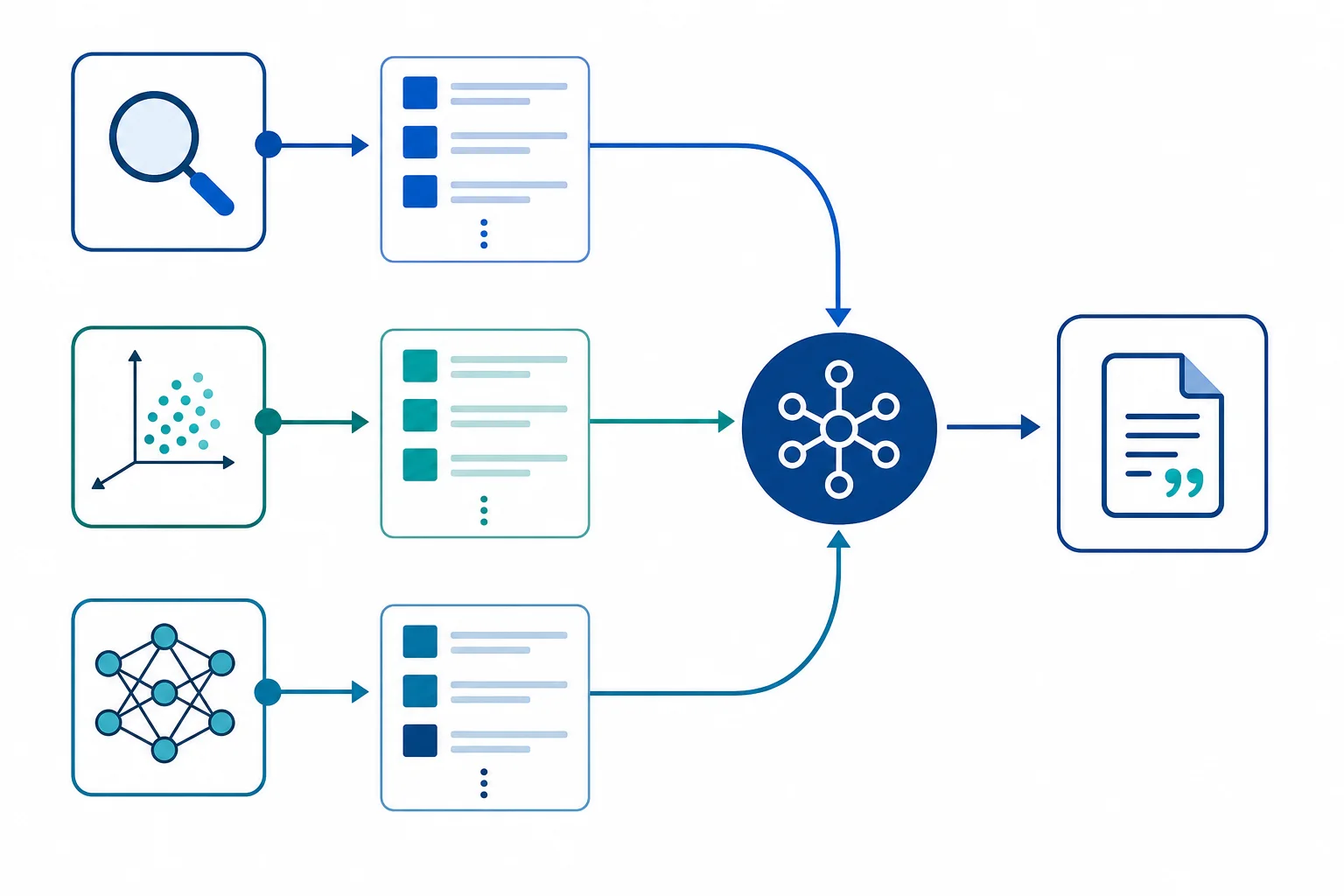
This is where Denser.ai takes a different approach from most agent platforms. Instead of relying on a single LLM to generate answers from its training data, Denser is built on a RAG architecture powered by the Denser Retriever — a hybrid retrieval engine that combines three search methods:
- Keyword search — exact term matching for precision queries (part numbers, policy sections, names)
- Vector semantic search — understanding meaning and intent, not just keywords
- ML reranking — a machine learning model that re-scores and orders results for maximum relevance
This hybrid approach outperforms standard vector-only search because different queries benefit from different retrieval strategies. A question like "What's our refund policy?" needs semantic understanding; a question like "Find section 3.2.2" needs exact keyword matching. Denser Retriever handles both.
Source Citations, Every Time#
Every response from a Denser-powered agent includes a source citation linking back to the exact page and passage it came from. If a visitor asks "What's your refund window?", the chatbot answers in plain language and links the exact policy page it pulled from — so both the visitor and the business can verify the answer.
This is the architectural difference that drops hallucination rates from 15–27% down to under 2%. When the agent can only answer from your verified documents — and must cite its source — it stops guessing.
KB Health: Catching Contradictions Before Users Do#
Denser also includes a KB Health feature that scans every connected document for conflicting facts and surfaces them with a confidence score. If your pricing-v1.pdf says something different from pricing-v2.pdf, you'll know before a customer does.
No-Code Deployment in 5 Minutes#
While frameworks like LangChain and CrewAI require engineering resources, Denser is built for deployment without code. You paste your website URL or upload PDFs, DOCX, or PPTX files, and Denser crawls and indexes everything — up to 100,000+ pages with no loss in answer accuracy. A single code snippet deploys the chatbot to WordPress, Shopify, Wix, Squarespace, Webflow, or any HTML page.
Build your own AI agent with cited answers →
The Future of AI Agents: 2026 and Beyond#
Forbes' Mark Minevich published 11 predictions for agentic AI in 2026. Here are the most consequential:
Every Employee Gets a Dedicated AI Assistant#
AI will move from answering questions to making recommendations and taking actions. Always-on assistants will handle HR tasks (onboarding, training, compliance, benefits), scheduling, forecasting, and inventory management. Gartner predicts 40% of enterprise applications will embed task-specific AI agents by 2026.
Multi-Agent Orchestration Becomes the Enterprise Breakthrough#
Single agents will evolve into orchestrated multi-agent systems, with dozens or hundreds of specialized agents collaborating on complex tasks — supply chain optimization, R&D pipelines, patient care journeys.
Physical AI Pilots Transform Manufacturing#
Humanoid robots will transition from demos to targeted commercial pilots, led by Tesla, Figure, and Agility. Nvidia's Jensen Huang calls this "the age of physical AI."
Guardian Agents by 2028#
By 2028, 40% of CIOs will demand "Guardian Agents" to autonomously track, oversee, or contain AI agent actions — a recognition that as agents become more autonomous, the need for oversight systems grows proportionally.
Vertical AI Agents Grow Fastest#
Vertical AI agents — domain-specific agents for BFSI, healthcare, legal, and engineering — are projected to grow at the highest CAGR of 62.7% (2025–2030), outpacing the overall market.
The Reality Check#
Forrester predicts enterprises will delay 25% of AI spend into 2027, and only 15% of AI decision-makers reported EBITDA lift in the past 12 months. The market is growing fast, but the gap between investment and returns remains wide.
How to Choose the Right AI Agent Approach#
Given the challenges above, here's a practical framework for deciding how to deploy AI agents in your business:
1. Start With Retrieval, Not Autonomy#
The biggest ROI comes from agents that answer accurately from your own data — not from agents that take autonomous actions. Get retrieval right first: cited answers, source verification, contradiction detection. Then expand to autonomous workflows.
2. Choose Cited Answers Over Free Generation#
If your agent is customer-facing, every answer should link to its source. This builds trust, reduces hallucinations by an order of magnitude, and gives your team a verification mechanism. Denser.ai is built specifically for this use case.
3. Deploy in 5 Minutes, Not 5 Months#
Most agent frameworks require weeks of engineering. If your use case is a website chatbot, internal knowledge base, or document Q&A, a no-code platform like Denser gets you live in minutes — with citations built in.
4. Monitor for the Klarna Problem#
Klarna's reversal teaches us that volume metrics (conversations handled) are not the same as quality metrics (customer satisfaction, accuracy). Deploy agents with monitoring for answer quality, not just efficiency.
5. Scale Gradually#
Start with a single well-defined use case (customer support, internal HR, knowledge base). Measure accuracy and satisfaction. Then expand to additional sources, languages, and workflows. The 95% failure rate is driven largely by over-scoping.
Frequently Asked Questions#
What is an AI agent?#
An AI agent is an autonomous system that perceives its environment, reasons about what to do, takes actions through external tools and APIs, and learns from results — all toward a goal without human direction at every step. Unlike a chatbot that responds one message at a time, an agent plans and executes multi-step tasks.
What's the difference between an AI agent and a chatbot?#
A chatbot follows predefined scripts and responds to messages one at a time. An AI agent takes a goal, breaks it into steps, calls tools and APIs, evaluates results, and decides the next action autonomously. Agents have memory, use multiple tools, and adapt to off-pattern situations.
What are the types of AI agents?#
IBM identifies five types: simple reflex agents (condition-action rules), model-based reflex agents (internal world model), goal-based agents (plan to achieve objectives), utility-based agents (optimize for best outcome), and learning agents (improve from experience). Multi-agent systems coordinate multiple specialized agents together.
What are real-world examples of AI agents?#
Notable examples include Klarna's customer service agent (2.3M conversations/month), OpenTable's Salesforce Agentforce agent (70% autonomous resolution), GitHub Copilot's coding agent (issue to pull request), Uber's Genie engineering bot (27% better answers via agentic RAG), Shopify Sidekick (merchant operations), and JPMorganChase LLM Suite (200,000 users).
How big is the AI agent market?#
The global AI agents market was valued at $7.63 billion in 2025 and is projected to reach $50+ billion by 2030, growing at a CAGR of approximately 46%. Enterprise agentic AI is projected to reach $24.50 billion by 2030.
Why do most AI agent projects fail?#
Gartner predicts 40%+ of agentic AI projects will be canceled by 2027 due to unclear business value, escalating costs, and inadequate risk controls. MIT found 95% of corporate AI initiatives show zero return. The main causes: FOMO-driven investment without clear use cases, hallucination rates of 15–27% in ungrounded deployments, lack of governance (only 21% of companies have mature governance), and over-scoping.
How can I reduce AI agent hallucinations?#
Ground every answer in retrieved source material with citations. Hallucination rates drop from 15–27% in unconstrained deployments to 0.7–1.5% when models are held strictly to source documents. Platforms like Denser.ai use hybrid retrieval (keyword + vector + ML reranking) and mandatory source citations to achieve this.
Getting Started#
The companies winning with AI agents aren't the ones with the most autonomous workflows — they're the ones with the most accurate, verifiable answers. Klarna scaled to 2.3 million conversations but had to reverse course on quality. Uber reduced incorrect advice by 60% specifically by upgrading its retrieval architecture.
If you're deploying an AI agent for customer service, internal knowledge, or document Q&A, the fastest path to a trustworthy deployment is a platform that combines hybrid retrieval with mandatory source citations.
Denser.ai lets you paste your website URL or upload documents, get a cited-answer chatbot live in 5 minutes, and scale to 100,000+ pages without losing accuracy. No code required.
Start building your AI agent →