
Semantic Search API: How to Add AI Search to Your Application

Building search into your application used to mean setting up Elasticsearch, writing complex query DSL, and tuning relevance manually. Semantic search APIs change that. They let you add meaning-based search to your product with a few API calls.
This guide covers what a semantic search API does, how it works under the hood, and how to integrate one into your application. For a foundational understanding, read our guide on what semantic search is.
What is a Semantic Search API?#
A semantic search API is a service that takes natural language queries and returns results ranked by meaning rather than keyword overlap. Instead of matching exact words, it understands what the user is asking and finds the most relevant content.
Under the hood, a semantic search API typically:
- Converts text into vector embeddings using transformer-based ML models
- Stores embeddings in a vector index for fast similarity search
- Processes queries by converting them into the same vector space
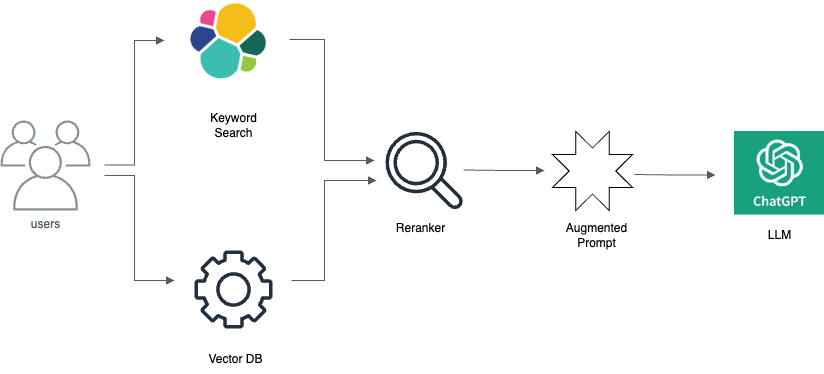
- Ranks results using a combination of vector similarity and neural re-ranking
This is fundamentally different from traditional keyword search, which relies on term frequency and inverted indexes. See our comparison of semantic search vs keyword search for a deeper look at the differences.
Why Use a Semantic Search API?#
Users Search in Natural Language#
People don't type boolean queries. They ask questions like "how do I reset my password" or "what's the refund policy for damaged items." A semantic search API understands these questions and finds answers even when the exact words don't appear in your documents.
Traditional Search Fails on Unstructured Data#
PDFs, Word documents, support tickets, knowledge base articles -- this content doesn't fit neatly into database columns. A semantic search API can ingest these documents, extract meaning, and make them searchable.
Building Search from Scratch is Hard#
Setting up Elasticsearch, training embedding models, building a re-ranking pipeline, and managing vector indexes is months of engineering. A semantic search API gives you all of this as a service.
Key Components of a Semantic Search API#
Document Ingestion#
A good semantic search API handles the full document processing pipeline:
- File parsing: Extract text from PDFs, DOCX, XLSX, PPTX, and other formats
- Chunking: Split documents into passages of optimal size for retrieval
- Embedding: Convert passages into vector representations
- Indexing: Store vectors for fast similarity search
Query Processing#
When a user submits a query, the API:
- Converts the query text into a vector embedding
- Searches the vector index for similar passages
- Applies neural re-ranking to improve precision
- Returns the most relevant passages with metadata
Knowledge Base Management#
For production applications, you need to organize documents into collections (knowledge bases), update content as documents change, and manage access control. The API should support creating, listing, updating, and deleting knowledge bases programmatically.
Building a RAG Pipeline with a Semantic Search API#
Retrieval-Augmented Generation (RAG) is the most common use case for semantic search APIs. Instead of relying on an LLM's training data, RAG retrieves relevant context from your documents and passes it to the LLM for answer generation. Learn more in our RAG guide.
A typical RAG pipeline:
- User asks a question in your application
- Semantic search API retrieves the most relevant passages from your knowledge base
- LLM generates an answer using those passages as context
- Your application displays the answer with source citations
This approach eliminates hallucinations because every answer is grounded in your actual documents.
Getting Started with Denser Retriever#
Denser Retriever provides a production-ready semantic search API with TypeScript and Python SDKs. Here's what a basic integration looks like:
1. Create a Knowledge Base#
Create a collection to organize your documents. Each knowledge base gets its own search index.
2. Ingest Documents#
Upload files or import text content. Denser Retriever handles parsing, chunking, and embedding automatically.
3. Query Your Data#
Send natural language queries and get ranked results with relevance scores.
The API supports both simple search queries and full RAG workflows where retrieved passages are used as context for LLM-based answer generation.
Choosing a Semantic Search API#
When evaluating semantic search APIs, consider:
- Retrieval accuracy: Does the API use neural re-ranking in addition to vector search? Combining keyword search, vector search, and ML re-ranking delivers better results than vector search alone.
- Document format support: Can it handle your file types (PDF, DOCX, etc.) natively?
- SDK availability: Does it have SDKs for your tech stack?
- Scalability: Can it handle your document volume and query load?
- Pricing: Is it cost-effective at your scale?
For a comparison of search infrastructure options, see our guides on Elasticsearch alternatives and Algolia alternatives.
Conclusion#
A semantic search API is the fastest path to adding intelligent search to your application. Instead of building and maintaining search infrastructure, you get meaning-based retrieval, document processing, and neural re-ranking as a service.
Denser Retriever provides exactly this -- a semantic search and document retrieval platform with production-ready APIs, TypeScript and Python SDKs, and enterprise-grade accuracy. Whether you're building a knowledge base, a support chatbot, or a document search interface, Denser Retriever handles the retrieval so you can focus on your product.