DenserAI Logo

Customer Support Chatbot: Guide + Top 5 Picks (2026)

milo
M. Soro
Updated: Jun 29, 202634 min read

Customer service is in the middle of its biggest shift in a decade. In 2026, the global AI customer service market is projected to reach $15.12 billion, up from $12.06 billion in 2024 — and 88% of contact centers already use some form of AI. Yet only 14% of customer issues actually resolve through self-service today. That gap is exactly where a well-deployed customer service chatbot makes the difference.

The conversation has also moved beyond simple FAQ bots. The biggest trend of 2026 is agentic AI — autonomous AI agents that don't just answer questions but take action: looking up orders, checking return windows, processing refunds, and closing tickets end-to-end without a human in the loop. Gartner predicts agentic AI will autonomously resolve 80% of common customer service issues by 2029, and leading companies are already hitting 55–70% automation in production today.

In this guide, you'll learn how customer service chatbots work, what to look for when choosing one, how the rise of AI agents changes the equation, and which five platforms deliver the best combination of intelligence, ease of use, and value in 2026. We'll also highlight the top chatbot tool — Denser.ai — that can help you scale your support no matter how large your customer base grows.

TL;DR — Quick Summary#

  • The best overall customer service chatbot for 2026 is Denser.ai, a RAG-powered AI chatbot that answers questions grounded in your own content with clickable source citations, starting at $29/month with a free plan available.
  • The 2026 shift is agentic AI. AI agents now resolve complex, multi-step issues autonomously — not just deflect them. Gartner predicts 80% of common issues will be auto-resolved by 2029.
  • Cost advantage is massive. AI self-service costs $1.84 per contact vs. $13.50 for agent-assisted support — a 7.3× difference (Gartner).
  • Companies see $3.50 back for every $1 invested in AI customer service, with 90% of CX leaders reporting positive ROI.
  • Resolution-based pricing is emerging. Platforms like Fin ($0.99/resolution) and Zendesk ($1.50–$2.00/resolution) now charge per issue resolved, not per seat.
  • Top 5 picks: Denser.ai, Chatfuel, ManyChat, Tars, and Intercom — compared in the table below.

Top 5 Customer Service Chatbots at a Glance#

PlatformBest ForStarting PriceAI ModelKey Strength
Denser.aiAI Q&A with cited, grounded answers$29/mo (free plan available)RAG-powered LLM with source citationsAnswers grounded in your own content; no-code setup
ChatfuelFacebook/Meta Messenger automationFree plan; paid from ~$15/moRule-based + GPT integrationDrag-and-drop flow builder for Messenger
ManyChatSocial media marketing automationFree plan; Pro from $15/moRule-based + basic AIInstagram, Messenger & SMS marketing flows
TarsConversational landing pages & lead genFrom ~$99/moRule-based conversational flowsHigh-conversion lead-gen chat forms
IntercomAll-in-one customer messaging + AI agentFrom $39/seat/mo (+ Fin AI $0.99/resolution)GPT-powered Fin AI agentLive chat + autonomous AI agent in one platform

What is an AI Customer Support Chatbot?#

A customer support chatbot helps businesses handle customer queries and issues around the clock. It uses artificial intelligence (AI), natural language understanding (NLU), and machine learning (ML) to understand and respond to customer service inquiries.

This chatbot can be embedded in websites, messaging apps, or social media platforms to provide instant support and assistance.

In 2026, the definition is expanding. Traditional chatbots answer questions. AI agents — the next evolution — take action. An agentic AI system can look up a customer's order, check the return window, process the return, issue a refund, and recommend a replacement, all in a single conversation without handing the customer off to a human agent. If you're exploring this for your own site, our guide to building an AI chatbot for your website walks through the practical steps.

How Do Customer Support Chatbots Work?#

Customer support chatbots work by processing user inputs (questions or statements) and then responding based on pre-programmed rules or using more advanced AI.

Simple chatbots follow a script and reply to questions based on set rules, while more sophisticated ones can learn from interactions and improve their responses over time.

AI and Natural Language Processing (NLP)#

The key technology behind advanced chatbots is NLP. It enables a chatbot to understand human language in a way that goes beyond simple keyword matching.

It allows the bot to recognize context, intent, and the nuances of conversation.

For example, a customer may ask, "Where's my order?" or phrase it differently as, "Can you check the status of my package?" With NLP, the chatbot can understand that both requests are asking for the same information and respond accordingly.

The more sophisticated chatbots rely on ML to improve over time. Machine learning allows the chatbot to learn from past conversations, adjust its responses, and predict customer needs with greater accuracy.

It has a self-learning capability that, as more customers interact with the bot, improves its ability to handle a wider variety of questions.

Retrieval-Augmented Generation (RAG): The Foundation of Accurate Chatbots#

The most reliable customer service chatbots in 2026 use a technique called retrieval-augmented generation (RAG). Instead of relying solely on a language model's training data, a RAG-powered chatbot first retrieves relevant information from your own knowledge base — your website pages, product docs, FAQs, and uploaded documents — and then generates an answer grounded in that content.

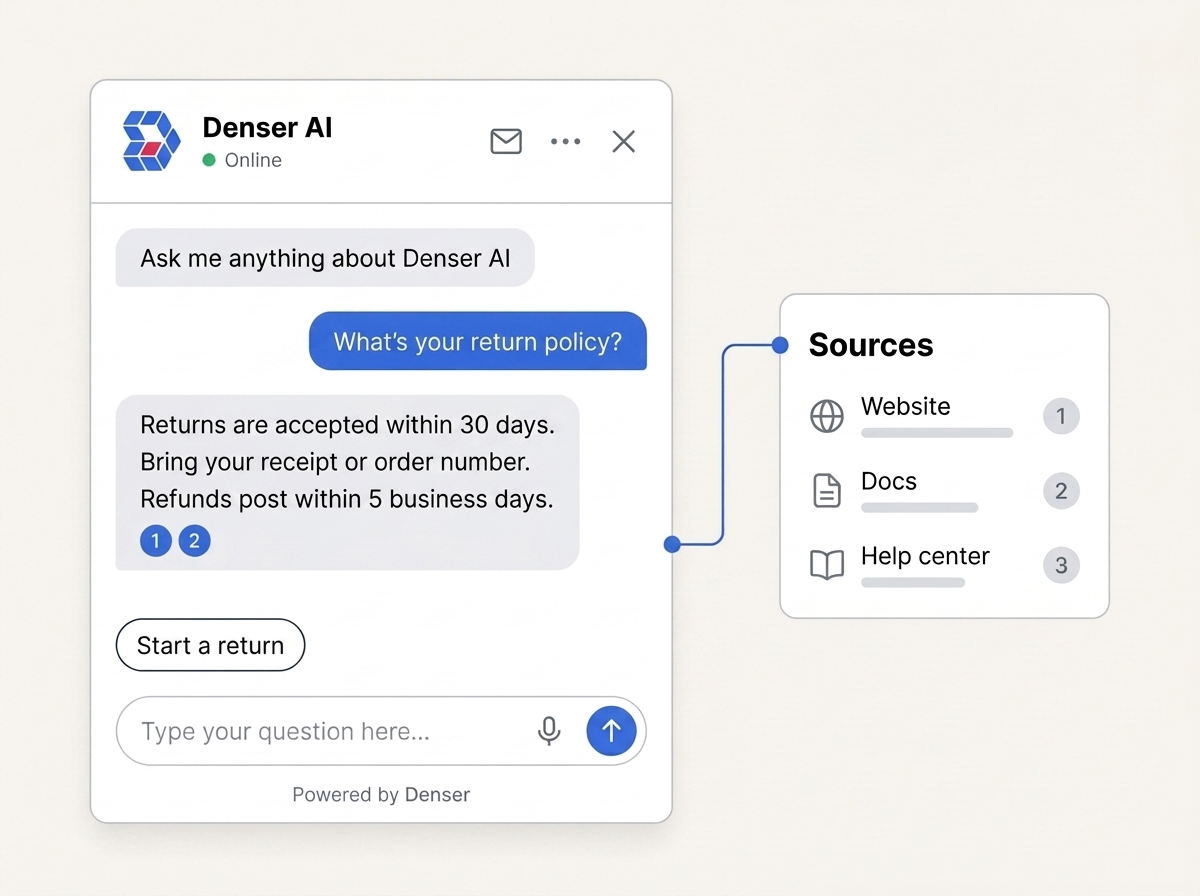
This matters because it dramatically reduces hallucinations. The chatbot answers based on your policies, your product specs, and your pricing — not generic internet data. Even better, platforms like Denser.ai include a clickable source citation with every response, so customers and support teams can verify exactly where an answer came from. For a deeper dive into how this technology works, see our guide to RAG (retrieval-augmented generation).

Rule-Based vs. AI-Powered Chatbots#

There are two primary types of customer support chatbots:

Rule-Based Chatbots: These are basic bots that follow predefined paths based on the user's input. They work best for answering simple and common questions, such as store hours, shipping policies, or return procedures. If a customer asks something beyond their programming, these bots will often prompt the customer to speak with a live agent.

AI-Powered Chatbots: These are more advanced and rely on AI and machine learning to provide intelligent responses. They can handle more complex customer requests, engage in longer conversations, and continuously learn from interactions to improve accuracy over time. AI-powered chatbots also have the ability to interpret the customer's tone or sentiment, which allows them to adjust their responses to be more personalized.

Integration with CRM and Other Systems#

Customer support chatbots can integrate with various business systems, such as Customer Relationship Management (CRM) software, payment gateways, and e-commerce platforms.

This allows chatbots to provide accurate, real-time information based on customer history, account details, and product availability. For enterprise use cases, explore our B2B chatbot examples showing how companies like Oracle, IBM, and Salesforce integrate chatbots with their systems.

When a customer asks about order status, the chatbot can pull up the information directly from the company's order management system and respond, "Your package was shipped on September 5th and is expected to arrive on September 8th."

Agentic AI and AI Agents: The 2026 Shift in Customer Service#

If there's one trend that defines customer service in 2026, it's the rise of agentic AI. The industry is shifting from AI-assisted support (where AI helps a human agent) to AI-operated support (where an AI agent resolves issues end-to-end on its own).

What Is Agentic AI?#

An AI agent is a step beyond a traditional chatbot. While a chatbot answers questions or deflects inquiries, an AI agent takes autonomous action to resolve the underlying issue. It can:

  • Access live business systems (CRM, order management, billing)
  • Execute multi-step workflows (check eligibility → process request → confirm outcome)
  • Handle complex, conditional logic (e.g., "if the item is within 30 days and in stock, process a return and issue a refund")
  • Close a ticket without escalating to a human — and escalate only when genuinely necessary

For example, instead of a chatbot saying "Please contact our returns team," an agentic AI system can look up the customer's order, verify the return window, generate a return label, process the refund, and confirm it — all in one conversation.

The Numbers Behind the Shift#

The data shows this is already happening, not just hype:

  • AI agent adoption jumped from 39% in 2025 to 66% in 2026 across customer service organizations (Salesforce research via Cygnet).
  • Gartner predicts agentic AI will autonomously resolve 80% of common customer service issues without human intervention by 2029, leading to a 30% reduction in operational costs.
  • Customer satisfaction is now the #1 improved KPI after AI agent deployment — ahead of agent productivity, average handle time, and first-response time (Salesforce).
  • AI-native platforms achieve 55–70% first-contact resolution at under $3 per resolution in 2026 production deployments.
  • 91% of customer service leaders report executive pressure to implement AI initiatives this year.

Resolution-Based Pricing: A New Model#

As AI agents take on more autonomous resolution, pricing models are evolving. The traditional per-seat model is being challenged by resolution-based pricing, where you pay per issue the AI resolves rather than per human agent seat.

  • Fin (Intercom): $0.99 per resolution
  • Zendesk AI: $1.50–$2.00 per resolution in overages, on top of seat pricing
  • Decagon: Custom per-conversation or per-resolution pricing

This shift aligns vendor incentives with customer outcomes — you pay for results, not access. It also makes ROI easier to measure: if a human-assisted contact costs $13.50 and an AI resolution costs under $3, the savings are direct and quantifiable.

What This Means for Your Business#

You don't need to jump straight to fully autonomous AI agents to benefit. The practical path in 2026 is:

  1. Start with a RAG-powered chatbot that answers questions accurately from your own content — this alone can deflect 35–75% of tier-1 inquiries.
  2. Integrate with your business systems so the chatbot can pull real-time data (order status, account details, inventory).
  3. Gradually add agentic capabilities — starting with the most common, repeatable workflows like returns, order modifications, and password resets.
  4. Keep humans in the loop for complex, emotional, or high-value interactions where empathy and judgment matter most.

Platforms like Denser.ai give you a strong foundation for step 1 and 2 with chatbot solutions that are ready to deploy in minutes, setting the stage for more advanced automation as your needs grow.

Benefits of Using AI Chatbots for Customer Service#

Customer support chatbots play a major role in modern customer service. With the rise of digital platforms, customer expectations have changed.

Businesses are now expected to provide fast, accurate, and reliable service around the clock. Chatbots help fulfill these expectations in several ways.

Denser_AI_Benefits_9

24/7 Availability#

Unlike human agents, chatbots can answer customer inquiries at any time of day to ensure that customers always get help when they need it. For businesses comparing live chat tools, our guide on LiveChat alternatives covers the top options for 2026.

AI chatbots deliver first responses in an average of 11 seconds, compared to a 4+ hour industry average for email support. 24/7 availability can directly impact customer satisfaction, and meeting this expectation is challenging without chatbots.

Cost Efficiency and Scalability#

Automating routine tasks like answering common questions can reduce operational costs for businesses.

The cost advantage is striking. According to Gartner, AI self-service costs $1.84 per contact compared to $13.50 per agent-assisted contact — a 7.3× cost advantage. At the extreme, some AI interactions cost as little as $0.50 compared to $8 per human interaction. Companies implementing AI support are seeing $3.50 back for every dollar invested, with returns ranging from 3.5× to 8×.

For example, instead of hiring additional support staff during peak seasons, a chatbot can handle the increased volume of inquiries without requiring extra resources.

This makes chatbots highly scalable, as they can manage thousands of conversations simultaneously. 75% of customer support specialists agree that AI and automation tools can help them spend less time on manual tasks like data entry and scheduling meetings.

Reduction in manual tasks allows support teams to focus on more complex issues that require human expertise.

Improved Customer Experience#

Chatbots do more than just reduce costs. Because they are available at any time, chatbots help reduce customer wait times, which is one of the biggest frustrations for customers.

Chatbots improve the overall customer experience by providing quick and accurate responses. They can handle queries, provide recommendations, and even complete transactions for smooth and pleasant interactions.

Reduction in Human Error#

Humans are prone to making mistakes, especially when dealing with repetitive tasks or during high-pressure situations.

Chatbots, on the other hand, offer consistency in responses. They are programmed to give the same answers to similar questions every time, which reduces the likelihood of errors.

Handling Repetitive Queries#

Many customer service inquiries are repetitive, such as checking order statuses, answering product questions, or providing shipping details.

Chatbots are ideal for automating these repetitive tasks, freeing up human agents to focus on more complex or high-priority issues.

According to IBM, chatbots can handle up to 80% of routine customer queries. This reduces the workload on support teams and improves efficiency. Self-service bots now resolve 54% of customer issues on average — and up to 96% for simple queries.

Customers also benefit from getting quick answers to their questions without needing to wait for human intervention.

Personalization#

Advanced AI chatbots can use customer data to provide personalized responses.

They remember past interactions and preferences, which makes the experience more relevant and engaging for the customer.

Data Collection and Insights#

Chatbots collect valuable data from customer interactions. This data can be analyzed to understand customer needs, preferences, and pain points, helping businesses improve their products and services.

Features to Look for in Customer Service Chatbots#

Choosing the right AI customer service chatbot for your business is crucial to ensuring it meets your customer service needs.

Here are the key features you should look for when selecting a support bot:

RAG-Powered Grounded Answers#

The most important feature in 2026 is whether the chatbot grounds its answers in your actual content. Look for a platform that uses retrieval-augmented generation to pull from your website, documents, and knowledge base — and includes source citations so answers are verifiable. This is what separates reliable AI chatbots from ones that hallucinate. Denser.ai includes source citations in every response, a feature that costs extra or isn't available on many competitor platforms.

Natural Language Processing#

NLP allows chatbots to understand and interpret human language. A good support bot should be able to understand different ways of asking the same question and respond appropriately.

Multi-Channel Support#

Your chatbot should be able to operate across various platforms, such as your website, mobile apps, and social media channels.

This ensures that your customers can reach out through their preferred communication method.

Integration with Existing Systems#

The support bot should integrate smoothly with your existing systems, such as your customer relationship management (CRM) and helpdesk software.

It allows the bot to gather customer information and provide more personalized support.

Agentic Capabilities and Autonomous Resolution#

In 2026, look for platforms that are moving beyond deflection toward autonomous resolution. Can the chatbot take action — not just answer questions? Can it access your business systems, execute workflows, and close tickets on its own? Even if you're not ready for full agentic AI on day one, choosing a platform with this capability built in ensures you won't outgrow it.

Personalization Capabilities#

A good support bot should be able to personalize interactions based on customer data.

It can remember past interactions and preferences, making each conversation relevant and engaging for the user.

Analytics and Reporting#

The chatbot should come with robust analytics and reporting features. This helps you track performance metrics such as response time, resolution rate, and customer satisfaction.

Insights from these reports can help you continuously improve your customer service.

Easy Setup and Customization#

The chatbot should be easy to set up and customize according to your business needs.

You should be able to design conversation flows, update responses, and make adjustments without extensive technical knowledge.

Security and Privacy#

Security is crucial, especially when dealing with customer data. Ensure the support bot uses strong encryption and complies with data protection regulations.

Multilingual Support#

If your business serves a global audience, the chatbot should be able to handle multiple languages. It ensures that all your customers receive support in their preferred language. Denser.ai supports 80+ languages out of the box on every plan.

Proactive Support#

Advanced chatbots can offer proactive support by identifying common issues and providing solutions before customers ask. It can significantly improve the user experience.

Continuous Learning#

AI-driven chatbots should be able to learn from every interaction and improve over time. This ensures the bot becomes more accurate and effective as it handles customer queries.

5 Best Customer Service Chatbots for 2026#

Selecting the best customer service chatbot can improve your business's efficiency and customer satisfaction.

Here are the top five customer service chatbots for 2026 that you should consider:

1. Denser.ai#

When it comes to delivering exceptional customer service through automation, Denser.ai stands above the rest.

Powered by RAG-based AI capabilities and designed with ease of use in mind, Denser.ai offers an unbeatable combination of intelligence and simplicity. Unlike rule-based bots that stall on anything unexpected, Denser.ai retrieves answers directly from your own website and documents — and includes a clickable source citation with every response so customers and agents can verify where the information came from.

Denser_AI_Example_1

Key Features That Set Denser.ai Apart#

  • Accurately understands and responds to customer queries using RAG-powered retrieval from your own content
  • Works seamlessly across your website, app, and social media
  • Connects with your CRM and helpdesk for personalized support
  • Delivers tailored answers based on customer history
  • Includes source citations in every response for verifiable accuracy
  • Tracks performance and customer satisfaction with built-in analytics
  • Anticipates customer needs and offers help before they ask
  • Supports 80+ languages on every plan
  • No-code setup — just enter your website URL or upload documents

If you're looking to experience its capabilities, Denser.ai offers a free plan that lets you explore the platform with no upfront cost:

  • 1 DenserBot
  • 20 queries
  • Space for 100 webpages or 50MB of documents
  • Continuous chatbot training

Denser.ai also provides flexible pricing options designed to meet the needs of businesses of all sizes, from growing startups to large enterprises. All plans include RAG-powered AI, source citations, and 80+ language support — features that cost extra or aren't available on competitor platforms:

PlanPriceDenserBotsQueries/moTeam MembersBest For
Free$01201Getting started, testing the platform
Starter$29/mo21,5001Individuals and small startups
Standard$119/mo47,5005Small teams needing advanced capabilities
Business$399/mo815,00010Growing businesses with higher volume
Enterprise$899/mo850,00050Large organizations with SLAs and scale needs

The Starter Plan at $29 per month offers 2 DenserBots and up to 1,500 queries per month — ideal for those who need more functionality without breaking the bank.

If you're part of a small team and need more advanced capabilities, the Standard Plan at $119 per month provides 4 DenserBots, 5 team members, and supports up to 7,500 queries per month with 2,000 webpages or 1GB of document storage per DenserBot.

For larger businesses, the Business Plan at $399 per month offers 8 DenserBots, 10 team members, 15,000 queries per month, and 10,000 webpages or 5GB of document storage per DenserBot — plus dedicated accuracy support.

For large organizations, the Enterprise Plan at $899 per month adds 50 team members, 50,000 queries per month, priority support, SLAs, and the option for private LLM deployment.

Pricing note: Denser AI uses usage-based tiers rather than per-agent seat pricing, which means you're not penalized for adding team members. Many competitors charge per seat — Zendesk AI starts at $55/agent/month plus AI add-ons — so costs can climb quickly as your team grows.

Sign up for a free trial or schedule a demo today with Denser.

2. Chatfuel#

Source: Chatfuel

Chatfuel_5

Chatfuel is known for its simplicity and extensive integration options, making it ideal for businesses looking to deploy chatbots quickly on Meta platforms (Facebook Messenger, Instagram).

Pros

  • User-friendly drag-and-drop interface
  • Seamlessly integrates with various tools such as CRM and email marketing platforms
  • Operates on platforms like Facebook Messenger and your website

Cons

  • Less flexibility for creating highly customized bots
  • Provides only basic analytics
  • Primarily rule-based, it may struggle with complex queries

3. ManyChat#

Source: ManyChat

Manychat_6

ManyChat excels in marketing automation and customer engagement, particularly on social media platforms.

Pros

  • Advanced tools for lead generation and customer engagement
  • Works on Facebook Messenger, Instagram, and SMS
  • Easy to set up and use, with a focus on marketing functionalities

Cons

  • More focused on marketing rather than AI-driven customer support
  • Integration options are somewhat limited compared to other platforms
  • It can become expensive as you scale up and add more features

4. Tars#

Source: Tars

Tars_7

Tars focuses on creating conversational landing pages, which are perfect for lead generation and customer support.

Pros

  • Conversational landing pages for user engagement and conversion rates
  • User-friendly interface allows for quick setup and deployment
  • Available on websites and messaging platforms

Cons

  • Lacks some of the advanced AI and NLP capabilities
  • Offers only basic insights into user interactions
  • Limited options for highly customized interactions

5. Intercom#

Source: Intercom

Intercom_8

Intercom combines live chat and chatbot features, providing a versatile customer messaging platform suitable for businesses of all sizes. In 2026, Intercom's Fin AI agent is one of the leading examples of resolution-focused agentic AI, billed at $0.99 per resolution.

Pros

  • Combines live chat and AI agent features (Fin AI for autonomous resolution)
  • Operates across the web, mobile apps, and social media
  • Provides detailed insights into customer interactions
  • Resolution-based pricing model aligns cost with outcomes

Cons

  • Premium features can be expensive for small businesses (seat pricing + per-resolution fees)
  • Integrating with other systems may require technical expertise
  • Best value realized at higher conversation volumes

How Different Businesses Use Customer Service Chatbots#

Customer service chatbots are becoming a go-to solution for many businesses, helping them provide better support and simplify operations.

Let's examine how businesses in different industries make the most of these smart tools.

Retail & Ecommerce#

In retail, chatbots are like personal shopping assistants available 24/7.

They can suggest products based on what you've bought, track your orders, and answer customer questions about returns or store locations. For a comprehensive guide on deploying chatbots in online stores, see our AI chatbot for ecommerce guide.

Technical Support#

Technical support chatbots help resolve common technical issues without the need for a human technician.

They guide users through troubleshooting steps, answer questions about software or hardware problems, and can even remotely diagnose issues.

These chatbots reduce wait times and improve user satisfaction by providing immediate assistance.

Healthcare#

In healthcare, chatbots help patients book appointments, check symptoms, and get reminders to take their medication.

They make it easier to get health advice without having to wait for a doctor.

Financial Analysis#

Chatbots assist users in understanding complex financial data and making informed decisions.

They provide real-time updates on stock prices, financial news, and market trends and can help users manage their portfolios.

For example, a financial chatbot might analyze spending patterns to offer budgeting advice or alert users to significant changes in their investment performance.

Travel and Hospitality#

Travel and hospitality companies use chatbots to make booking and travel smoother.

Chatbots can help you book flights, hotels, and car rentals, provide real-time updates on flight status, and answer common travel questions.

Real Estate#

Real estate chatbots provide information on property listings, schedule viewings, and answer questions about buying or renting. They give you all the details about available properties, like prices and features, and you can book appointments with agents.

Education#

Chatbots assist with admissions, course information, and student support. They answer questions about admission requirements, deadlines, and applications and provide details on courses and enrollment.

Steps to Implement a Customer Service Chatbot for Your Business#

Implementing a customer service chatbot can improve your business's efficiency and customer satisfaction. Here's how you can provide superior customer service using an AI chatbot:

Identify Your Goals#

Consider what types of tasks the chatbot will handle, such as answering frequently asked questions, processing orders, or managing complaints.

You should identify your customers' most common inquiries and whether the chatbot will need to integrate with other systems like CRM or payment platforms.

Having a clear understanding of your objectives will help you choose the right chatbot solution for your business.

Choose the Right Chatbot Platform#

After identifying your business needs, it's time to select the most suitable chatbot platform.

Look for a solution that matches your goals, whether it's offering easy setup, advanced AI capabilities, or strong integration options with your existing tools.

Platforms like Denser.ai provide a highly scalable solution, ideal for businesses looking to automate their support with minimal technical effort.

Denser.ai offers an intuitive, no-code setup. You can get started quickly by simply inputting your website URL or uploading documents.

It also integrates with your CRM and other systems to ensure your chatbot delivers fast, personalized support.

Evaluate how user-friendly the platform is — does it require coding, or is it a simple drag-and-drop interface?

If you're looking for something that can grow with your business, ensure the platform offers scalability.

Denser.ai is designed to adapt as your business expands, offering both AI-powered chat capabilities and multi-channel support to meet increasing demands.

Design the Conversation Flow#

A well-designed conversational flow ensures that your chatbot can better engage your customers.

You should map out the typical queries customers will ask and craft responses that guide them to solutions.

Also, keep the language simple and clear to avoid confusion and incorporate decision trees or guided prompts to assist users in navigating their queries.

It's also essential to plan for instances where the chatbot doesn't know the answer.

In these cases, make sure the issue can be seamlessly escalated to a human agent, ensuring the customer's journey isn't interrupted.

Train and Test the Chatbot#

For your chatbot to be effective, it needs access to accurate and relevant information.

Start by uploading your FAQ section, product information, shipping details, and return policies. This will allow the chatbot to provide helpful responses to routine questions.

If you're using an AI-powered chatbot like Denser, it will learn from each interaction and improve its answers over time. Because Denser.ai uses RAG, every answer is grounded in your uploaded content with source citations — so accuracy depends on keeping your knowledge base current.

However, it's still important to regularly update its knowledge base as your business develops to ensure it always provides the most accurate information to your customers.

Deploy the Chatbot#

Deploy the chatbot on your preferred platforms. Ensure it is easily accessible on your website, mobile app, and social media channels.

Make the chatbot visible and easy to use so customers know they can reach out for support anytime.

Monitor and Optimize#

After deployment, continuously monitor the chatbot's performance. Track metrics such as response time, resolution rate, and customer satisfaction.

Collect feedback from users to identify areas for improvement. Regularly update the chatbot's knowledge base to keep it relevant and useful.

Best Practices for Customer Service Chatbots#

Using customer service chatbots can greatly improve your business, but it's essential to follow best practices to ensure they are effective. Here are some key strategies:

Blend Automation with Human Touch#

While AI customer service chatbots can handle many tasks, it's important to know when to switch to a human agent.

Automation should never replace human interaction entirely. There will always be situations where a chatbot cannot fully understand or resolve a customer's issue, particularly when emotions or complex queries are involved.

In these instances, chatbots should be designed to smoothly escalate the conversation to a human agent.

The chatbot should recognize the tone of the interaction and transfer the customer to a live agent who can offer personalized support.

This is especially relevant as agentic AI adoption grows — the goal is autonomous resolution for routine issues and seamless human handoff for everything else, not removing humans from the equation entirely.

Personalize Interactions#

Personalization can make a huge difference in customer experience, even when interacting with a bot. Using available data can make conversations feel more personal and relevant.

For example, a chatbot can greet the customer by name, reference their previous purchases, or offer tailored recommendations based on browsing history or preferences.

Monitor Performance and Collect Feedback#

It's essential to monitor performance metrics to ensure your chatbot is delivering maximum value. Key performance indicators (KPIs) to track include:

  • Response time
  • Customer satisfaction (through post-interaction surveys)
  • Issue resolution rate
  • Escalation frequency to human agents
  • First-contact resolution (FCR) — the percentage of issues resolved in a single interaction
  • Cost per resolution — especially relevant if you're comparing resolution-based pricing models

Collecting and analyzing this data will help identify areas where the chatbot excels and where improvements are needed.

Additionally, gathering direct feedback from users provides valuable insight into how customers perceive the chatbot experience.

If certain queries lead to repeated escalations, this could indicate a gap in the chatbot's knowledge base or conversational flow that needs addressing.

Maintain Security and Privacy#

As chatbots often deal with sensitive customer information, security and privacy must be top priorities.

Chatbots should comply with relevant data protection regulations and ensure that customer data is stored and processed securely.

Keep Your Knowledge Base Current#

One of the most common reasons chatbots underperform is stale content. If your pricing, policies, or product catalog changes and your chatbot's knowledge base isn't updated, customers get wrong answers — and trust erodes fast. With a RAG-powered platform like Denser.ai, keeping things current is as simple as re-uploading your documents or re-crawling your website.

5 Reasons Why You Should Choose Denser#

Here are the five key reasons why Denser.ai should be your go-to customer support chatbot solution:

  1. Get started in minutes without any technical expertise. Just enter your website URL or upload your documents, and your chatbot is ready to assist your customers with answers grounded in your own content — complete with source citations.
  2. Provide your customers with fast, accurate responses anytime they need help. No waiting, just efficient service that leaves a positive impression. AI self-service at $1.84 per contact vs. $13.50 for agent-assisted support means the savings compound with every interaction.
  3. Denser.ai learns from every interaction, getting better and more personalized over time. Your chatbot will provide smarter, more relevant responses with each conversation.
  4. As your business grows, Denser.ai grows with you. Manage hundreds or even thousands of customer inquiries without hiring more staff. Let the chatbot handle routine questions while your team focuses on complex tasks.
  5. Turn customer inquiries into conversions with Denser.ai by providing fast, real-time responses at any time of day — with pricing that scales by usage, not by seat, so you're never penalized for growing your team.

Transform Your Customer Support with Denser.ai's AI-Powered Chatbots#

Never make your customers wait again. Deliver personalized responses 24/7 and turn every interaction into an opportunity for better engagement with Denser.ai.

This AI-powered customer support creates better customer relationships, helps you attract new customers, and simplifies customer service processes.

Don't miss out on the advantages of a great chatbot platform. Make your website more engaging and improve customer interactions with Denser.ai.

Sign up for a free trial or schedule a demo now and see how Denser.ai can transform your customer service!

FAQs About Chatbots for Customer Service#

What is the difference between a chatbot and an AI agent?#

A traditional chatbot answers questions and deflects inquiries — it provides information but doesn't take action. An AI agent (powered by agentic AI) goes further: it can access business systems, execute multi-step workflows, process transactions (like refunds or returns), and resolve issues end-to-end without human intervention. In 2026, the industry is shifting from chatbots that deflect to AI agents that resolve. Gartner predicts agentic AI will autonomously resolve 80% of common customer service issues by 2029.

What happens if a chatbot makes a mistake?#

If a chatbot makes a mistake, it's important to have a system in place for customers to report the issue. The chatbot should apologize and, if possible, transfer the conversation to human customer service teams to resolve the problem. With RAG-powered platforms like Denser.ai, mistakes are less likely because answers are grounded in your own content with source citations — but continuous monitoring and updates help minimize errors over time.

Are there any limitations to what chatbots can do?#

While chatbots are powerful tools, they have limitations. They may struggle with understanding highly nuanced or emotional conversations, require accurate initial training data, and depend on quality content to function effectively. Human intervention is still necessary for complex, emotional, or high-value issues. The best approach is to let AI handle routine queries autonomously and seamlessly escalate to humans when empathy or complex judgment is needed.

How do chatbots stay current with business updates?#

Businesses need to regularly update their knowledge base with new information, such as changes in policies, new products, or updates in services. With a RAG-powered chatbot like Denser.ai, this is as simple as re-uploading documents or re-crawling your website — the chatbot immediately retrieves answers from the updated content. This ensures that the chatbot always provides accurate and relevant information to customers.

Is resolution-based pricing better than per-seat pricing?#

It depends on your volume and use case. Resolution-based pricing (like Fin's $0.99/resolution or Zendesk's $1.50–$2.00/resolution) aligns cost with outcomes — you pay for results, not access. This can be more cost-effective at high volumes. Per-seat pricing can be better if you have many human agents but lower AI resolution volume. Denser.ai uses usage-based tier pricing (starting at $29/mo), which avoids per-seat penalties while still scaling with your needs. For a detailed pricing comparison across 10 platforms, see our AI chatbot pricing comparison.

Share this article

Get started

A chatbot worth shipping, live in minutes.

Point Denser at your website, docs, and PDFs. It answers in minutes, every reply cited to its exact source.

No code. Free to start. Cancel anytime.