
Best Customer Service Management Software in 2026: Complete Buying Guide

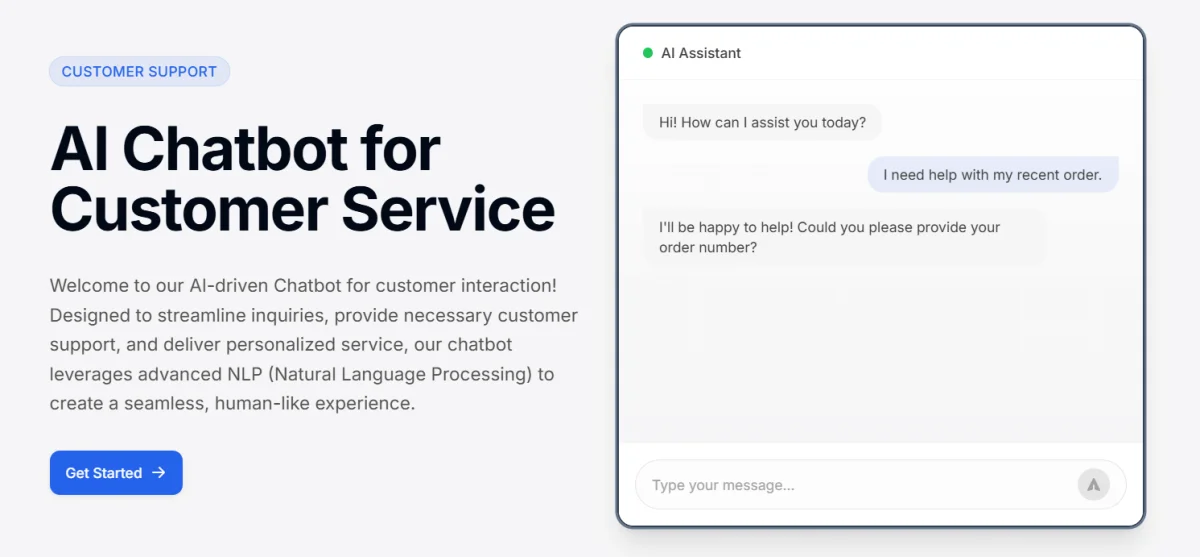
In 2026, customer service management software is no longer just a ticketing system — it has become a core operational platform that directly impacts support efficiency, labor costs, and customer satisfaction.
Choosing the wrong platform can be more expensive than most teams expect:
- Long deployment cycles that fail to meaningfully reduce repetitive inquiries
- Inaccurate AI responses that increase complaints and rework
- Complex systems with high costs that still do not solve the real support bottleneck
The purpose of this article is not to present a feature checklist, but to help businesses answer one critical question:
In 2026, what type of customer service management software truly solves your support bottlenecks while improving efficiency at the lowest operational cost?
Drawing on Denser AI's experience across real-world customer support and AI automation deployments, we will compare leading platforms across:
- AI automation capabilities
- Ticket management infrastructure
- Deployment complexity
- Total cost of ownership (TCO)
So you can make a clearer decision aligned with your team size and growth stage.
By the end of this article, you will clearly understand:
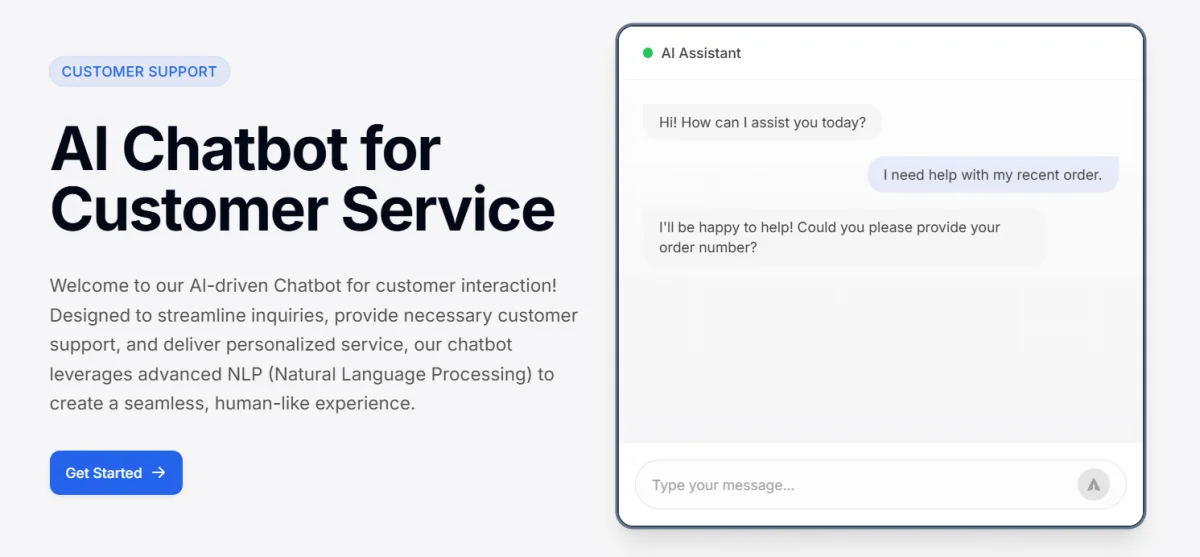
- Which tools are best suited for AI-first automated support
- Which platforms are built for complex support operations
- How to avoid paying for features your team does not truly need
1. AI Automation Capabilities: Can It Actually Reduce Repetitive Work?#
In 2026, the biggest shift in customer service management software is the role of AI.
For many teams, 50–70% of incoming tickets are repetitive, including:
- Return policies
- Shipping timelines
- Product compatibility
- Basic troubleshooting
The real question is not whether a platform "has AI," but whether that AI can reliably handle these questions without creating new problems.
Two Dominant AI Approaches#
| Approach | How It Works | Strength | Limitation |
|---|---|---|---|
| AI layered on top of a helpdesk | Uses general-purpose LLMs to draft replies from help center content | Easy to activate within existing systems | May lack precise source traceability |
| AI-first systems built on document retrieval (RAG) | Retrieves answers directly from approved documentation with citation | Higher accuracy and traceability | Requires structured documentation |
Denser AI Insight: Why Retrieval Architecture Matters#
From Denser AI's deployment experience, automation success is strongly correlated with answer traceability.
When AI responses are grounded in approved documentation and supported by source citation, support teams spend less time correcting responses and more time resolving complex issues.
If your primary bottleneck is repetitive, documentation-based inquiries, AI accuracy is not a secondary feature — it is the core requirement.
2. Ticket Management Infrastructure: Do You Need Operational Control?#
Not every company's bottleneck is automation.
Larger teams often struggle with:
- Ticket routing by priority or customer segment
- SLA tracking
- Escalation workflows
- Agent performance reporting
Operational Infrastructure Comparison#
| Platform Type | Best For | Core Capability |
|---|---|---|
| Full-stack helpdesk | Complex support teams | Workflow control, SLA management, multi-channel support |
| AI-first automation platforms | High-volume repetitive inquiries | Automated Q&A, document-based support |
Strategic Decision Logic#
- If your challenge is workflow complexity, prioritize infrastructure.
- If your challenge is volume of repetitive inquiries, prioritize AI automation.
3. Deployment Complexity: Time to Value Matters#
Traditional helpdesk systems may require:
- Workflow configuration
- Agent training
- Integration setup
- Automation rule design
This can take weeks or months before measurable impact.
Deployment Timeline Comparison#
| Platform Category | Typical Time to Value |
|---|---|
| Traditional helpdesk systems | Weeks to months |
| AI-first automation systems | Same day to a few days |
Implementation Note#
Across Denser AI implementations, shorter deployment cycles consistently correlate with faster internal adoption and measurable ROI.
For growing teams or product launches, time-to-value can materially impact performance outcomes.
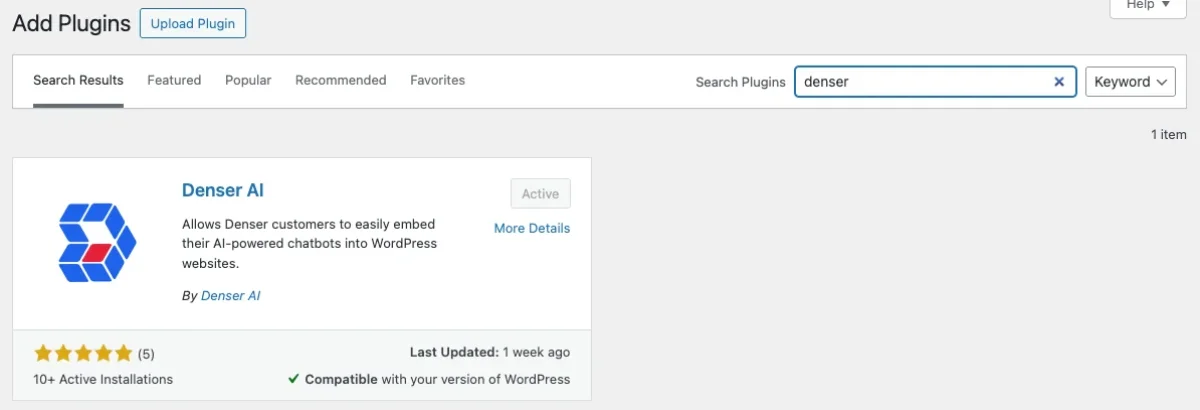
For teams deploying on WordPress, Denser AI provides a step-by-step integration guide. You can follow the official WordPress installation tutorial here to complete the setup: WordPress Integration Guide.
4. Total Cost of Ownership (TCO): Subscription Is Only One Part#
When evaluating cost, consider:
- Per-agent subscription fees
- AI interaction or resolution fees
- Implementation costs
- Administrative overhead
- Engineering time
Cost Structure Comparison#
| Cost Factor | Helpdesk Platforms | AI-First Platforms |
|---|---|---|
| Per-agent fees | High at scale | Minimal or none |
| AI usage fees | Often per-resolution | Typically automation-based pricing |
| Implementation overhead | Higher | Lower |
| Operational cost impact | Workflow-focused | Ticket-volume reduction focused |
A platform that appears affordable per seat may become expensive at scale.
Conversely, AI-first automation may reduce total headcount needs by lowering ticket volume.
Cost Evaluation Insight#
Based on Denser AI's experience analyzing automation ROI, cost efficiency improves most when automation first targets high-frequency, low-complexity inquiries.
Unlike many full-stack customer service platforms that charge per agent seat or per AI resolution, Denser AI's pricing structure is based primarily on usage tiers rather than agent count.
Denser AI offers a free tier and scales through fixed monthly plans (for example, Starter at $29/month and Standard at $119/month), with each tier defining clear query limits and document storage capacity.
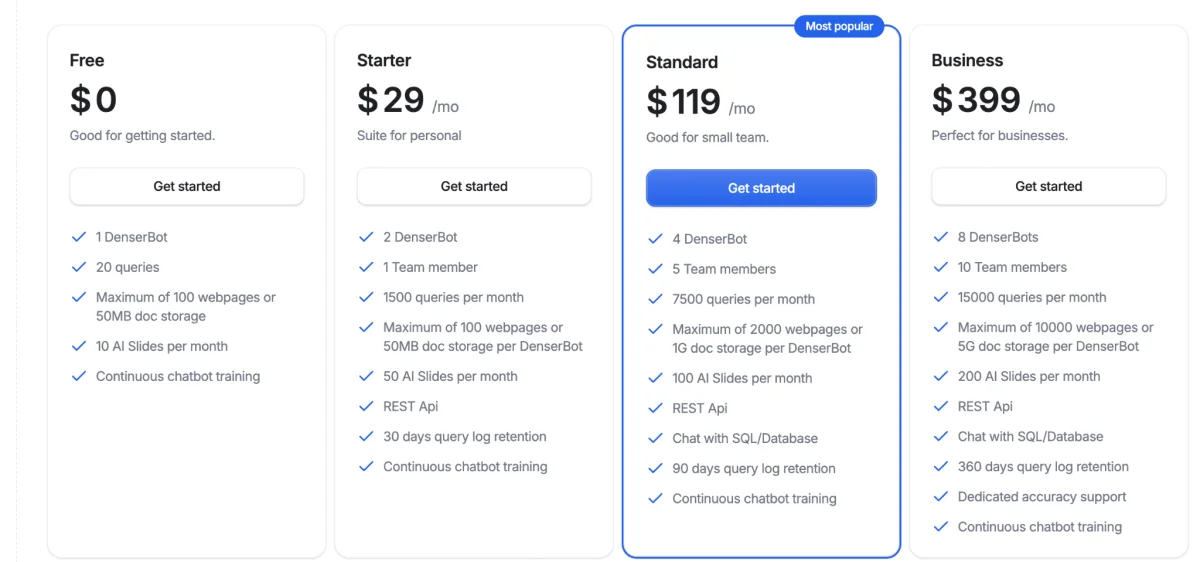
Within automation-focused use cases, this structure reflects several characteristics:
- No per-agent seat fees
- Clear and predictable monthly pricing
- Reduced overall support costs as repetitive tickets decrease
- Built-in document storage and retrieval without requiring additional CRM modules
For teams prioritizing automation-driven cost reduction, aligning pricing structure with actual ticket patterns often matters more than comparing headline subscription fees alone.
Explore our pricing plans and choose the tier that fits your needs on our Pricing page.
5. Matching Software Type to Business Stage#
Early-Stage or Small Teams#
- Limited support staff
- High repetitive ticket volume
- Budget sensitivity
Best fit: AI-first automation or lightweight helpdesk.
Mid-Market Teams#
- Growing ticket volume
- Need structured workflows
- Hybrid AI + human support
Best fit: Combined automation + scalable helpdesk.
Enterprise-Level Operations#
- 50+ agents
- Complex routing
- Multi-channel support
Best fit: Mature infrastructure, potentially complemented by AI automation.
The Best Tool Solves Your Real Bottleneck#
In 2026, the best customer service management software is defined by bottleneck resolution — not feature volume.
If your team is overwhelmed by repetitive inquiries, AI-first systems can deliver measurable efficiency gains.
If your organization struggles with workflow orchestration and SLA compliance, full-stack platforms may be more appropriate.
Practical Selection Framework#
- Identify your primary support constraint.
- Test platforms using real workflows and customer questions.
- Measure time-to-value, accuracy, and cost impact.
The right solution reduces friction, improves accuracy, and scales with growth — without introducing new operational overhead.
As support requirements evolve across different growth stages, the automation approach should align with your operational model.
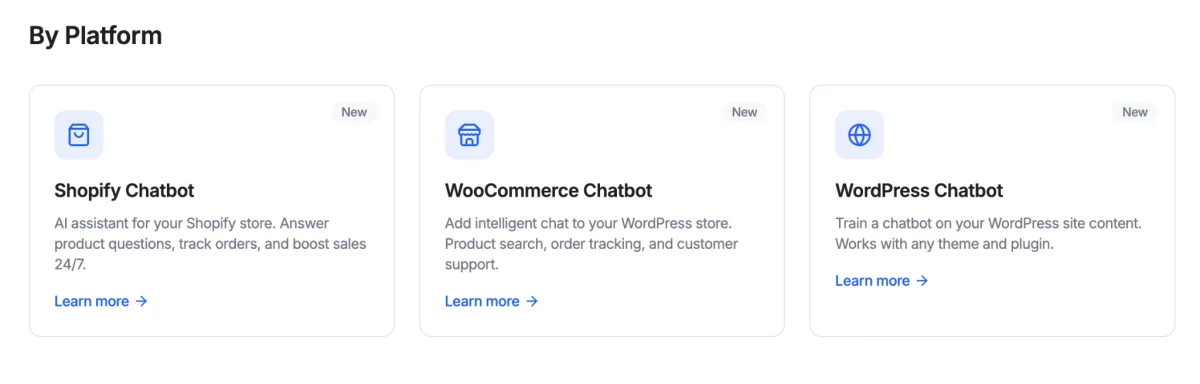
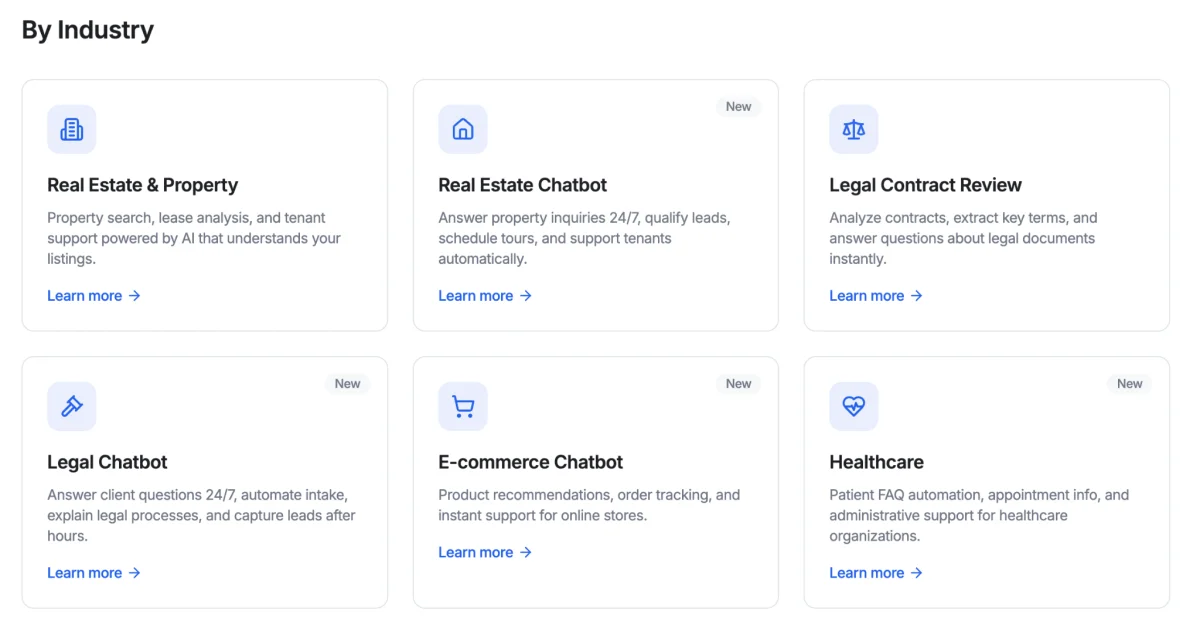
Denser AI's solutions overview outlines use cases across customer service, ecommerce, and internal knowledge management — allowing teams to identify the approach that best fits their needs.
Explore Denser AI's Solutions#
Evaluate the Right Automation Approach#
The right solution should reduce operational friction, improve answer accuracy, and scale with your business — without adding unnecessary overhead.
For teams that prioritize AI accuracy and fast deployment, exploring retrieval-based automation can be a practical next step.
Denser AI offers solutions including a Customer Service Chatbot, E-commerce Chatbot, and an Internal Knowledge Base Assistant, designed to automate repetitive support inquiries while grounding responses in verified documentation.
If you would like to better understand how these solutions may apply to your business, or if you have specific questions about your support workflows, feel free to connect with our team for further discussion.