
AI Chatbots vs Traditional Helpdesk Software: A Smarter Alternative in 2026

Traditional helpdesk software relies on ticket-based workflows, where customer inquiries are handled manually by support agents.
This works at a smaller scale, but as inquiry volume grows, response speed, staffing costs, and limited service hours quickly become bottlenecks.
AI chatbots offer a more efficient alternative. By handling routine questions instantly on the front end, they reduce ticket volume, improve response speed, and enable 24/7 support.
This article helps you choose the right solution based on your business needs and support structure.
Response Speed: Instant Answers vs Queued Waiting#
Traditional ticketing systems depend on human agents' processing speed and the current queue length. During peak periods, customers may wait hours or longer before receiving a reply.
AI chatbot responses are instant. After a customer asks a question, the AI retrieves relevant information and delivers an answer within seconds, regardless of queue length or business hours.
According to industry data, AI-assisted customer service interactions are on average 47% faster than purely human-handled ones.
For questions with clear answers — such as order inquiries, product specifications, and return policies — this speed difference directly impacts customer experience.
Handling Capacity: Automated Routine Questions vs One-by-One Manual Processing#
In most businesses, a significant proportion of support tickets are repetitive: order status, delivery timelines, return processes, product specifications, and similar questions.
In a traditional ticketing system, every inquiry requires a human agent to open the ticket, look up the information, and write a response. Even for identical questions, the same process is repeated each time.
AI chatbots can automatically identify these routine questions and answer them instantly, with no human involvement needed. Industry data shows that in businesses using AI chatbots, up to 60% of routine tickets are resolved through self-service, allowing human agents to focus on more complex issues.
Coverage Hours: 24/7 Availability vs Business Hours Only#
Traditional ticketing systems rely on human staffing schedules. Inquiries submitted outside business hours typically wait until the next working day for a response. For businesses serving global customers, timezone differences amplify this problem further.
AI chatbots are not limited by business hours and can provide instant responses at any time. This is especially important for ecommerce, SaaS, and service businesses operating across timezones — customers get immediate help whenever they visit, regardless of the hour.
Cost Structure: Predictable Fixed Costs vs Scaling Labor Costs#
The operating cost of a traditional ticketing system is directly tied to team size. Growing inquiry volume means more agents, which brings ongoing costs for hiring, training, and management.
AI chatbots have a different cost structure. According to industry data, the average cost per human agent interaction is approximately $6.00, while an AI chatbot handles the same inquiry for roughly $0.50. As inquiry volume grows, the unit cost advantage of AI becomes more pronounced.
It is worth noting that this does not mean human teams can be eliminated entirely. AI is well suited for handling routine, high-frequency inquiries, while complex issues and sensitive situations still require human agents.
The practical approach is to let AI absorb the volume of routine inquiries while human teams focus on high-value interactions.
Information Accuracy: Real-Time Data Retrieval vs Manual Lookup#
In a traditional ticketing workflow, agents need to manually look up order information, verify inventory status, confirm policy details, and then compose a response. This process is time-consuming and carries the possibility of human error.
AI chatbots can retrieve information directly from a business's product data, order systems, and policy documents, generating answers based on real-time data. When product information or policies change, AI responses update automatically without manual intervention.
Some AI chatbots also support source links in their answers, pointing to the relevant product page or policy page so customers can verify the information themselves. This has practical value in reducing information disputes and building customer trust.
Feature Comparison Overview#
| Dimension | AI Chatbot | Traditional Helpdesk Software |
|---|---|---|
| Response Speed | Instant (seconds) | Depends on queue and agent availability |
| Routine Question Handling | Automatic identification and response | One-by-one manual processing |
| Coverage Hours | 24/7 | Limited by agent schedules |
| Cost Model | Primarily fixed monthly fee, low unit cost | Scales linearly with team size |
| Information Source | Auto-retrieves from business data | Agent manually looks up and replies |
| Answer Verifiability | Some tools support source links | Depends on agent's response |
| Complex Issue Handling | Requires handoff to human | Human handles directly |
| Emotionally Sensitive Scenarios | Limited capability | Humans are better suited |
Denser AI: Built for Automating Routine Customer Inquiries#
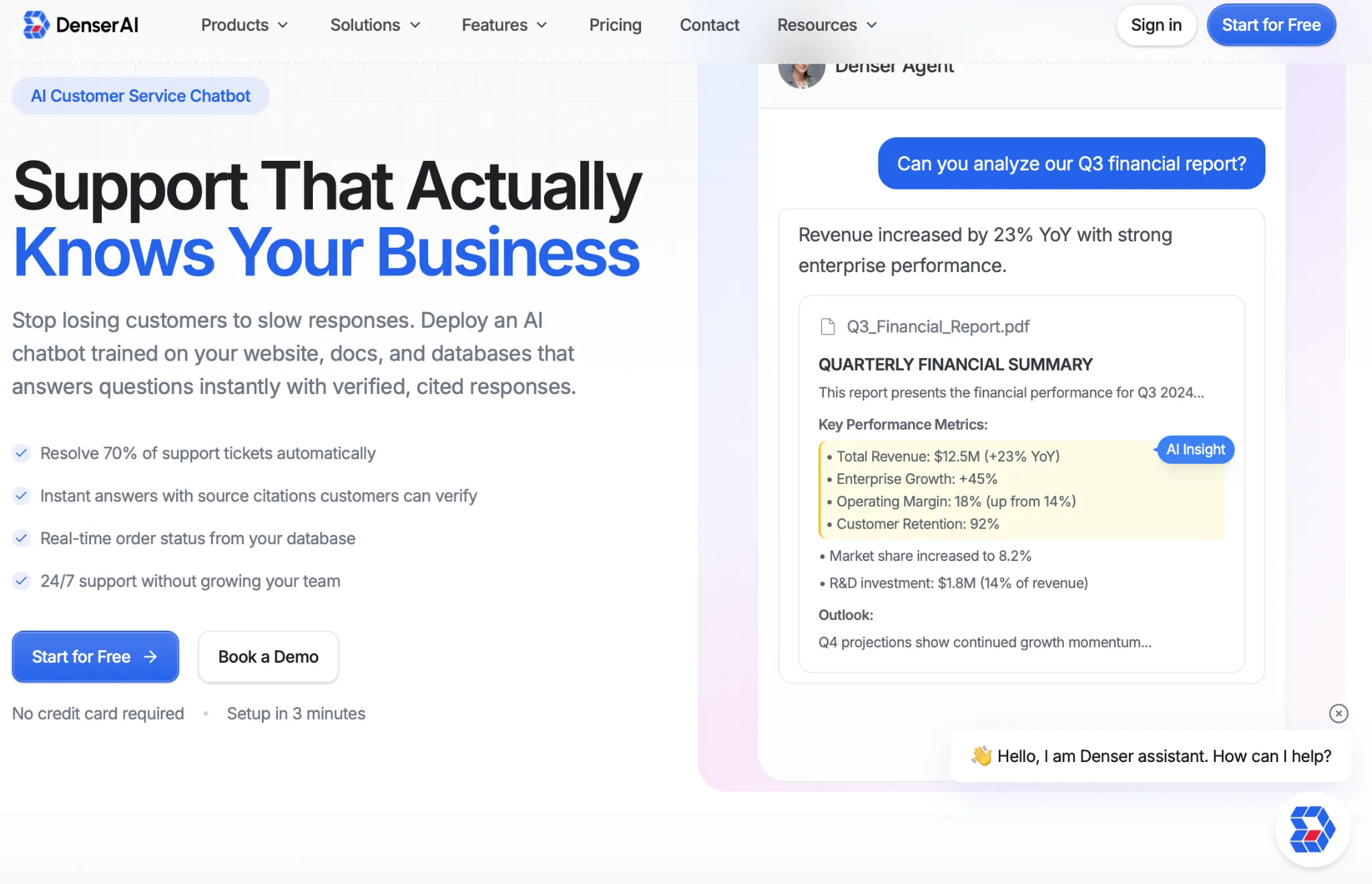
Denser AI chatbot provides a complete solution across the dimensions outlined above.
Automatic business data learning — learns directly from your product catalog, policy documents, and order systems without manual FAQ configuration. Responses update automatically when data changes.
In-chat real-time order tracking — customers can check order status and shipping details directly in the conversation, without navigating to another page or waiting for a human agent.
Answers with source links — each response can link to the relevant product page or policy page, allowing customers to verify information and reducing disputes.
Deploy in minutes — connect your business data source and sync completes automatically. No engineering resources required.
Starting at $29/month with flat monthly pricing and no usage-based hidden costs.