
How AI Chatbots Help Businesses Improve Customer Service Efficiency

As businesses grow, the pressure on customer service teams grows with them — inquiry volumes keep rising, customer expectations for response speed keep climbing, and the rising cost of labor makes expanding the team harder and harder to justify.
More and more businesses are bringing AI chatbots into their customer service operations.
But after deployment, the ones that see real results are fewer than expected. The problem usually isn't the AI technology itself — it's that the tool choice and implementation approach didn't match the actual business needs.
This article starts from the core pain points in enterprise customer service, walks through what AI chatbots can genuinely do in a support context, and covers what to look for when choosing the right tool for your business.
The Real Reasons Behind Poor Customer Service Efficiency#
Repetitive Work Is Draining Your Support Team#
Picture this: an experienced customer service agent spends a third of their day answering "how do I return an item," "how long does shipping take," and "how do I reset my password." The answers to all of these are already written clearly in the help center.
The problem isn't that the team isn't working hard enough — it's that these repetitive questions keep flooding in without stopping.
Every simple question answered means a complex case that genuinely needs human judgment is sitting in the queue a little longer. Customers are waiting, issues are piling up, and the team is burning out.
As the business scales, this problem multiplies. Inquiry volume doubles, but the team can't grow at the same pace.
The result: longer response times, declining customer satisfaction, and increasing agent turnover — which only makes the problem worse.
Customers Won't Wait, But Your Team Can't Be Online 24/7#
Modern customers have less patience than most businesses realize. For e-commerce platforms, a customer browsing late at night who is ready to place an order but can't get an answer to a last-minute question will likely abandon the purchase entirely.
The reality is that customer service teams can't be online around the clock. Nights, weekends, and peak business periods — these are exactly when customer demand is highest and human coverage is thinnest. Every unanswered inquiry during these windows is a potential customer lost.
Outdated Information Turns Customer Service Into a Liability#
Product launches, policy updates, promotional changes, shipping rule revisions — business information is constantly changing. But knowledge base updates in customer service systems often lag behind.
When agents answer based on outdated information, or different agents give inconsistent answers, the customer doesn't just think "this response was wrong." They think "this company is unprofessional." Once trust erodes, customer churn tends to be silent — they don't complain, they just don't come back.
Mountains of Customer Data Are Sitting Idle#
Hundreds or thousands of customer inquiries every day carry real signals about user needs: which feature confuses users most, which policy description is unclear, which type of issue spikes at certain times.
But in most businesses, this data either goes unrecorded or is recorded and never analyzed. The support team is too busy handling tickets to extract insights from them. The result: the same problems keep recurring, the same mistakes keep happening, and the business stays in firefighting mode instead of ever getting ahead of the issues.
How AI Chatbots Change This#
Hand 70% of Repetitive Work to AI — Let Your Team Focus on What Matters#
The core value of an AI chatbot isn't to replace human agents — it's to free them to do work that's actually worth doing.
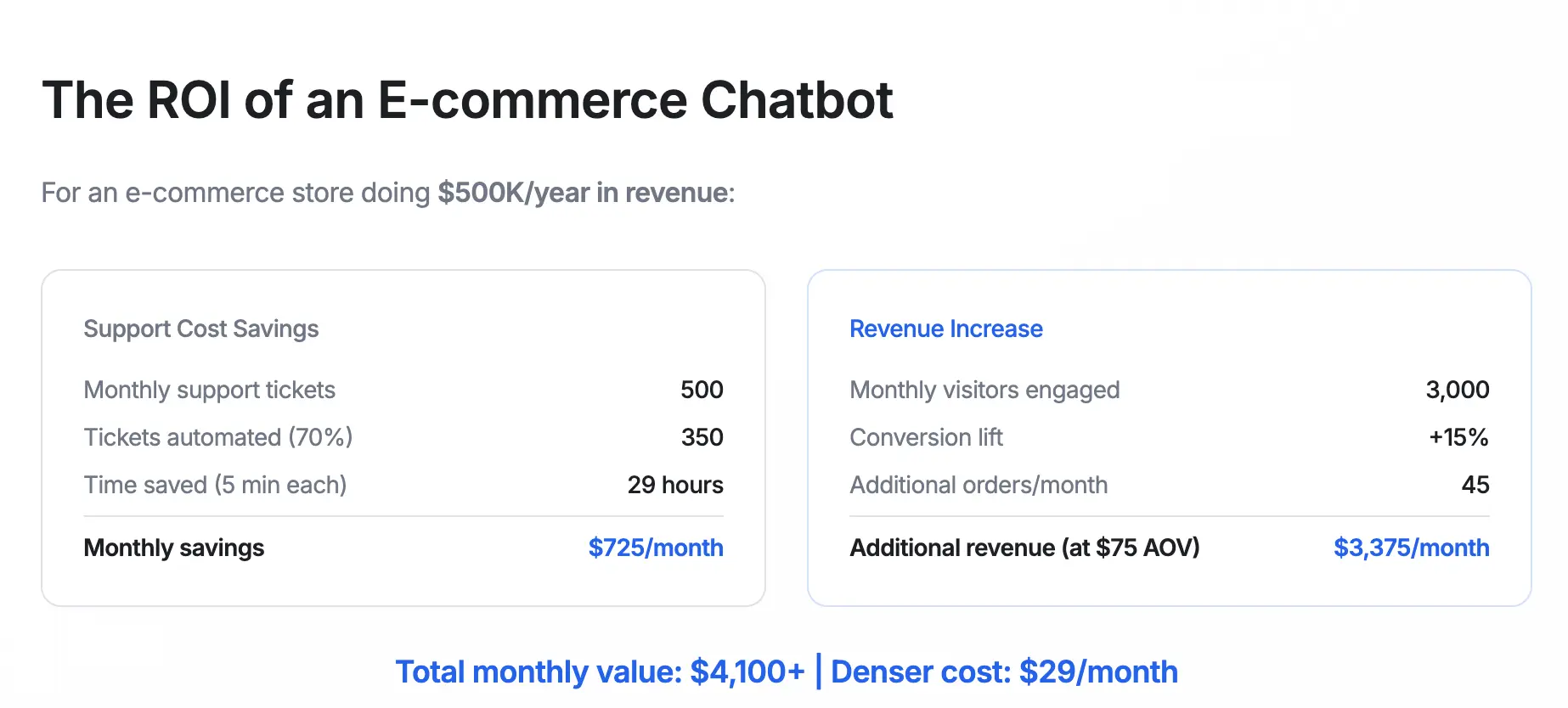
Once a business connects its help center articles, product manuals, and policy documents to an AI platform, the chatbot can automatically handle high-frequency repetitive inquiries around the clock. According to platform data, Denser AI can help automatically resolve up to 70% of support tickets.

What does that 70% mean in practice?
It means the support team can shift more than two-thirds of their time away from answering return policy questions — and toward handling complex escalations, following up with high-value customers, and improving service processes. That's where human agents are genuinely irreplaceable.
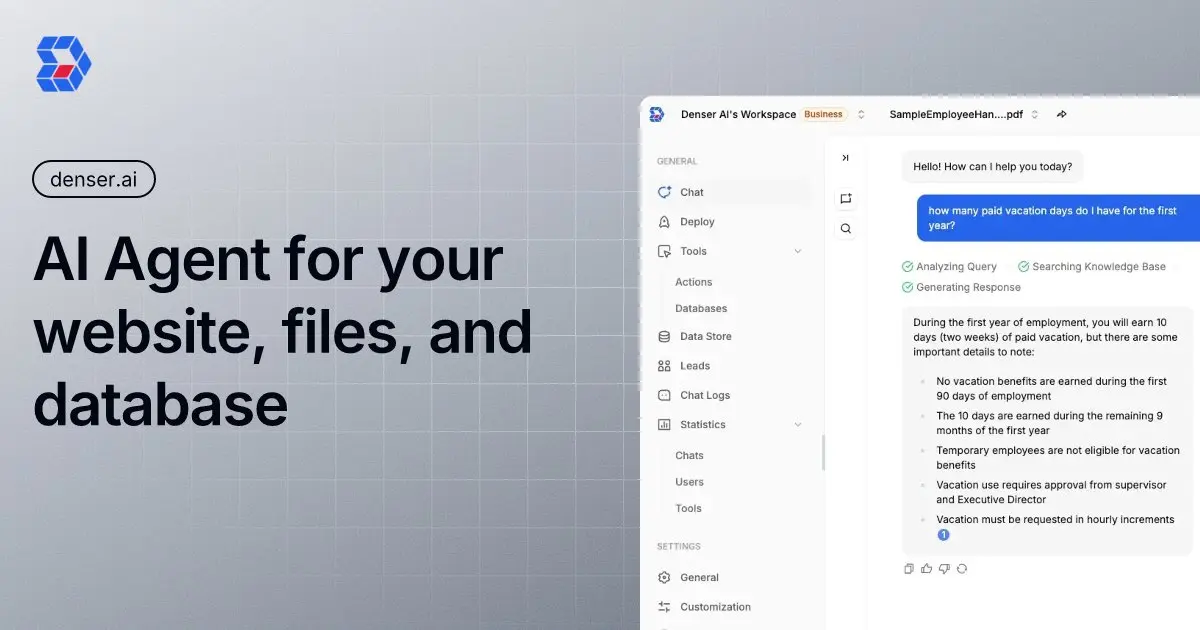
Denser AI uses a RAG architecture, generating every response from the organization's own connected content with source citations attached.
Customers can verify where the information came from at any time. If the answer isn't in the business's data, the system says so rather than guessing. When a question exceeds the AI's scope, the conversation transfers seamlessly to a human agent.
Fill the 24/7 Gap — Stop Losing Customers to Unanswered Questions#
An AI chatbot doesn't need rest and isn't bound by time zones. Nights, weekends, peak periods — whenever a customer reaches out, the AI responds immediately.
For e-commerce teams, this means a customer browsing late at night gets their last question answered before checkout.
For businesses with cross-border operations, it means customers in every time zone receive the same quality of service experience.
Every immediate response is a potential lost customer recovered.
Automatic Content Sync — Eliminate Information Lag at the Source#
Denser AI automatically synchronizes connected data sources. When a business updates its website content or documents, the system re-indexes automatically — no manual updates required.
This means: on the day a new product launches, the AI can already answer questions about it accurately.
When a policy changes, the AI's responses immediately reflect the new rules. During a promotional period, the AI's information is fully consistent with the current campaign. Information lag is eliminated at the source.
Turn Support Conversations Into Sales Opportunities#
A visitor who reaches out through your website at midnight and actively initiates a conversation is often one of your highest-intent potential customers.
But without AI present, that visitor's contact information disappears forever — they won't leave their email to wait for a response the next morning.
Denser AI's website chatbot supports lead capture, collecting visitor contact information through custom forms during the conversation and converting inquiry traffic into actionable sales leads — automatically, around the clock, with no human involvement required.
For B2B businesses or e-commerce with high-ticket products, a single successfully captured lead can generate business returns many times greater than the cost of the tool.
Put Customer Data to Work — Build a Continuous Improvement Loop#
Denser AI provides complete query logs and usage statistics. Businesses can clearly see: which questions customers ask most, which questions the AI can't handle well, which time periods see the highest inquiry volumes, and how customer satisfaction trends over time.
This data is the raw material for service improvement. Which product description confuses users most? Which policy needs to be rewritten? Which step in the process generates the most complaints? The answers are in the query logs.
Regularly reviewing this data and continuously refining the knowledge base creates a positive cycle — as the knowledge base improves, AI performance improves, and customer service quality compounds over time.
80+ Languages — One System, Global Coverage#
Building dedicated support teams for every language market is expensive and difficult to manage. Denser AI supports over 80 languages. Businesses maintain one core knowledge base, and the AI serves customers in their own language — no need to configure separate resources for each market.
What You Can't Compromise On When Choosing an AI Customer Service Tool#
Responses must be grounded in your own business data: General-purpose AI tools rely on pre-trained public data and can easily get the specifics of your policies and products wrong. An AI that gives a customer incorrect return policy information is more damaging than having no AI at all.
Content updates must sync automatically
Manually maintaining a knowledge base is one of the most common reasons customer service automation fails. Choose a tool that can automatically keep pace with business changes.
Deployment must be simple enough
Denser AI supports no-code deployment. Adding it to a website requires nothing more than embedding a code snippet — compatible with WordPress, Shopify, and other major platforms — and can go live in as little as 5 minutes, with no engineering support needed.
Responses must be verifiable
Source citations don't just build customer trust — they give businesses a clear audit trail, so there's something to point to when a dispute arises.
Frequently Asked Questions#
What types of customer service questions are AI chatbots best suited for?
AI chatbots work best for inquiries with clear, factual answers — product information, policy explanations, operational procedures, and account questions.
For situations requiring complex judgment or emotional support, a human handoff mechanism should be in place.
Do businesses still need human customer service teams after bringing in AI?
Yes. The value of an AI chatbot is in handling repetitive inquiries so human agents can focus on higher-value work — not in replacing them. The two working together is what actually improves overall service efficiency.
How can businesses make sure AI responses are accurate?
Choosing a tool that generates responses from the business's own data is the foundation.
Denser AI uses RAG architecture to ground every response in real business documents, with source citations attached. If the answer isn't in the business's data, the system acknowledges this rather than guessing.
Will the AI automatically update when customer service content changes?
Yes. Denser AI automatically synchronizes connected data sources. When documents or website content are updated, the system re-indexes automatically — no manual updates needed.
How should businesses measure the actual impact of AI customer service?
Key dimensions to track include: the percentage of tickets handled automatically, changes in human agent workload, customer satisfaction scores, and improvements in response time.
Denser AI's query logs and usage statistics provide the data to support all of these metrics.